SEO improves a website’s visibility in unpaid search results, helping people find relevant products, services, and expertise when they need them. An effective SEO strategy for business growth connects technical website quality, keyword research, and useful content with customers’ questions, then measures whether that visibility supports meaningful business outcomes.
For organizations across Saudi Arabia, SEO starts with understanding how prospective customers search, what information helps them decide, and which pages can meet those needs clearly. Rankings alone are not the goal. Relevance, trust, and a useful experience help turn search visibility into a more effective customer journey.
This article explains what SEO involves, how keyword research guides content, and how a sustained, measured approach can support growth. It also clarifies when SEO should work alongside other marketing channels.
• Build SEO around technical site health and a planned response to search algorithm changes, rather than chasing every update.
• Prioritize search terms that reflect customer intent, including specific phrases that signal a clear need.
• Choose local or broader SEO based on where your customers are and how they search for your products or services.
• Create useful content that answers real customer questions, then assess its contribution to meaningful business outcomes.
Search Engine Optimization (SEO) improves a website so search engines can understand its pages and show them for relevant searches. It combines technical optimization, useful content, and a clear mobile experience across devices. In digital marketing, organic search visibility helps customers find a business without relying only on paid placements. A 2023 BrightEdge survey reported that over 68% of online experiences begin with a search engine.
Search algorithms change, so effective SEO requires ongoing attention rather than a one-time fix. Monitor organic traffic, rankings, and page performance, then investigate meaningful shifts before changing strategy. For example, if Google changes how it presents results, a drop in clicks may reflect the results page rather than a sudden decline in customer demand. Keep technical quality and helpful content central instead of chasing every update.
Rankings influence which businesses gain visibility, but they do not establish credibility on their own. The top five organic Google search results account for 69.1% of all clicks, making search competition consequential. Compare the results for your company name and key products or services: competitors may occupy prominent positions, while clear, relevant pages can help establish your expertise. Consistent information and useful answers give visitors stronger reasons to trust what they find.
SEO supports long-term visibility because useful pages can continue attracting relevant visitors after publication. It may take at least six months to show results, and a new website may take longer. SEO is therefore better suited to sustained visibility than an immediate campaign. Put rankings in context: a position matters most when it brings the right audience to a page that meets their needs.
To measure traffic, leads, and revenue, track organic visits alongside contact form submissions, phone calls, and sales attributed to website pages. Review these measures together: traffic shows reach, enquiries indicate potential demand, and attributed sales connect search activity with revenue. Rankings and clicks help explain changes, but they are not business outcomes on their own.
Keyword research identifies the terms customers use and the purpose behind each search. A specialist can group an initial shortlist of 20 to 50 keywords by intent, then assess which terms suit the business, its audience, and its pages. For example, “accounting services” signals a broad need, while “accounting services for small businesses” expresses a more specific requirement. Long-tail searches often indicate stronger buying intent, even when they receive fewer searches. An SEO strategy for business growth uses this distinction to prioritize relevant demand over traffic volume alone.
Search intent matters more than volume alone. Someone searching “what is an audit” needs an explanation, while a person searching “book a financial audit” may be closer to choosing a provider. Base research on your actual customer groups and the language they use, including whether English or Arabic terms fit the audience. Competitor results can also reveal which page types and topics appear for relevant searches.
Conversational queries, such as “how do I choose a reliable supplier?”, help shape clear answers and headings. Google introduced AI Overviews in 2024, making direct, well-structured explanations useful for search experiences that summarize information. Keyword rankings show where pages appear for selected terms, but a strong position matters only if the query reaches relevant customers. Connect rankings to audience needs and useful landing pages.
Use keywords naturally. Repeating a phrase unnaturally, known as keyword stuffing, can make a page difficult to read and may undermine its visibility. Publishing near-identical pages for slight keyword variations creates duplicate content without giving customers a distinct answer. Give each page a defined purpose, such as comparing options or explaining a specific service.
Black-hat SEO uses manipulative methods, such as hidden text, copied pages, or artificial links, to influence rankings. These tactics can reduce visibility or lead to Google enforcement, putting accumulated search efforts at risk. A sound marketing approach prioritizes useful pages, clear intent, and distinct content over shortcuts.
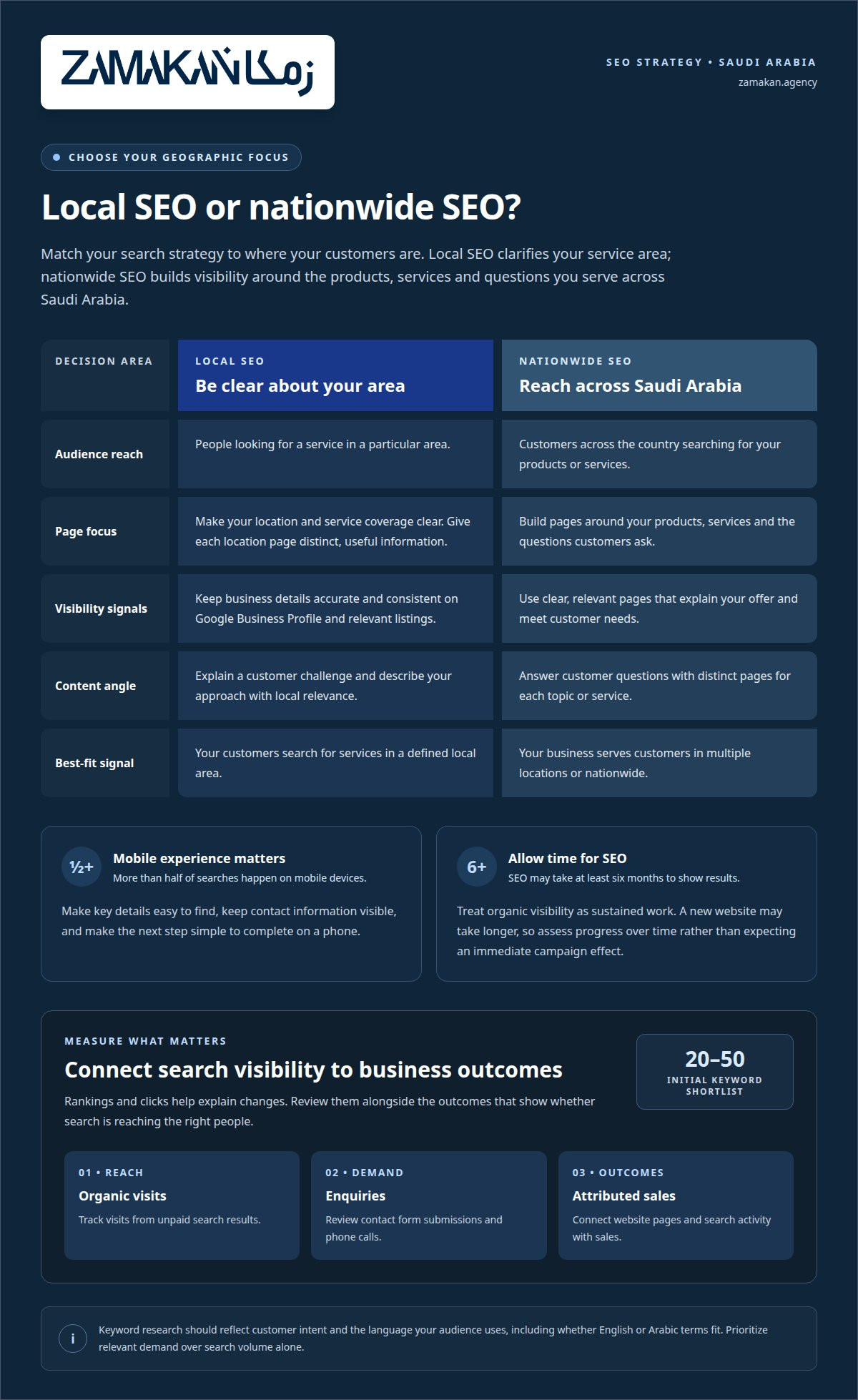
SEO can support growth by connecting relevant organic traffic with pages that meet customer needs. Local search targets people looking for services in a particular area, while broader small-business SEO can reach customers across Saudi Arabia. Businesses serving a defined local area should make their location and service coverage clear. Businesses serving customers nationwide can build pages around their products, services, and customer questions.
For local visibility, keep business details accurate and consistent on Google Business Profile and other relevant listings. Make it easy for customers to understand what you offer and how to reach you. Original expert content can strengthen local relevance: a professional services firm, for example, might explain a common customer challenge and describe its approach. Each location page should provide useful, distinct information rather than repeating the same text with a different place name.
Mobile optimization matters because more than half of searches happen on mobile devices. Make key details easy to find and actions simple to complete on a phone. Someone looking for a nearby service should be able to understand the offering, find contact information, and take the next step without navigating a desktop-focused page. Keep website information aligned with business listings.
Local SEO can help businesses attract nearby customers by making their services, location, and contact details easier to find in local search. Paid search provides visibility while an advertisement is running; organic search can continue surfacing relevant pages without paying for each click. Businesses can combine these approaches according to their goals, timing, and available resources.
When evaluating an SEO provider, assess how its tools inform decisions, how it measures qualified traffic and enquiries, and how its research reflects Saudi search behaviour. Look for a clear explanation of how recommendations connect audience needs, business locations, mobile experience, and measurable outcomes. A useful assessment should explain the work behind its recommendations, not rely on rankings alone.
Local SEO can help businesses in Saudi Arabia attract nearby customers by making their services, locations, and contact details easier to find in local search. Accurate business listings and useful, distinct location pages help customers understand the offering and take the next step.
Useful content begins with a real audience need, not a keyword target. A sound SEO strategy for business growth starts by identifying what visitors need to understand before choosing a product or service. A Saudi customer comparing delivery options, for example, needs clear coverage details, delivery expectations, and next steps. Content should answer accurately, explain unfamiliar terms, and help potential customers decide what to do.
Original expertise gives an answer substance. A finance firm could explain what documents a small business should prepare before an initial consultation, then clarify how its process works. Avoid copying competitor pages or adding generic paragraphs to increase length. Instead, have subject specialists review claims and examples before publication, then refine the content so the advice is precise, useful, and relevant to its audience.
Structure shapes the experience. Use a descriptive heading for each distinct question, followed by a direct answer and supporting detail. A frequently asked question can receive a concise answer of 50-60 words, while a complex topic may need examples or a comparison. This organization helps readers scan digital content and understand what action to take next.
Rich content can clarify a process that is difficult to follow through text alone. For instance, an existing how-to video can demonstrate a product setup, while a written summary gives visitors key steps and context. Keep the page useful without the video and make its purpose clear. A relevant next step, such as a contact form beside an explanation of service options, can support conversion without distracting from the answer.
Content audits identify pages that need updating, consolidation, or removal. Review each page’s accuracy, audience fit, organic visits, and contribution to enquiries. If two pages answer the same question, combine their strongest information into one clear resource. If a service page attracts visitors but few enquiries, assess whether its claims, examples, and next step match customer expectations. This gives your content program a practical basis for prioritizing edits and measuring their effect on engagement and conversions.
Zamakan Agency connects search visibility priorities with a wider marketing plan through Advisory, Media, and SEO/SEM. Turn to the team when your organization needs to clarify SEO priorities, assess technical or content gaps, or align search activity with other marketing channels.
Its Media Planning & Buying service can coordinate media decisions around your audience and business objectives. This is useful when organic search needs to work alongside paid media rather than in isolation. Priorities depend on your customer journey, the pages you need to strengthen, and how you will measure progress through relevant traffic and enquiries.
For a joined-up view of your marketing priorities, contact Zamakan Agency to discuss your needs.
Connect search work with the business decision it should support. Choose a clear priority, such as strengthening qualified enquiries, improving visibility for a key service, or helping customers compare options. Then align the responsible teams around the pages, resources, and measures needed to make progress. An effective SEO strategy for business growth guides those choices while responding to customer needs and changing search behaviour.
For organizations seeking strategic direction across search and wider marketing activity, Zamakan Agency offers Advisory, Media, and SEO/SEM. Its team can help frame priorities and connect SEO decisions with business objectives, giving your next actions a clear purpose.
Contact Zamakan Agency to discuss your SEO priorities and take a considered next step toward stronger search visibility.
SEO makes website pages easier for search engines to discover, interpret, and present for relevant searches. It can involve improving page structure, clarifying what a service offers, and making information accessible to visitors. For example, a service page should explain its offering directly rather than rely on a vague slogan to convey meaning.
SEO can connect your business with people already researching a need, helping them consider your solutions before choosing a provider. A useful comparison page, for example, can help a prospective customer understand which option fits their situation. Growth depends on reaching an appropriate audience through search and giving visitors a clear path to enquire or buy.
Search engines discover pages by following links, analyze their content, and store eligible pages in an index. When someone searches, the engine selects and orders results based on relevance and other signals. A clear page title, descriptive headings, accessible links, and accurate content help search engines interpret a page and help users decide whether it meets their needs.
An SEO professional can assess technical barriers, content gaps, and how well pages match search intent, then prioritize changes against business objectives. For example, an audit may find that a key service page is difficult to navigate or lacks details customers need before enquiring. A professional can coordinate recommendations with your team and track whether changes improve qualified visits and enquiries.
AI is changing how search systems interpret questions and present information. Google introduced AI Overviews in 2024, while search systems increasingly interpret intent rather than relying only on exact keyword matches. Businesses can respond by publishing accurate, clearly structured information that answers specific customer questions. AI can support research or analysis, but editorial review remains essential for accuracy, relevance, and a distinct point of view.