
The broadest service list does not automatically make an agency the right choice; the stronger fit is the team whose media expertise, measurement approach and operating model align with your organisation’s goals in Saudi Arabia.
That is the practical purpose of a media planning agency comparison: to assess how agencies handle programmatic buying and attribution, which benchmarks inform their recommendations, and whether their related services, locations and sector specialisms fit your audience, campaign scope and internal requirements.
Use the criteria that follow to look beyond polished credentials, understand how technical capability connects to measurable planning decisions, and compare support across channels and markets. This can help you identify a partner whose strengths match the work ahead and set clear expectations for how performance will be assessed and improved, including how its approach accounts for differences between sectors, cities and customer groups across Saudi Arabia.
• Compare in-house, agency and hybrid buying models by how they support platform access, campaign execution and attribution needs.
• Use documented client work, reviews and relevant benchmarks to assess an agency’s expertise beyond its claims.
• Account for Saudi advertising compliance, location and sector specialism when judging whether an agency can serve your market.
• Match the partner’s related services to your priorities so planning, measurement and wider marketing activity work together.
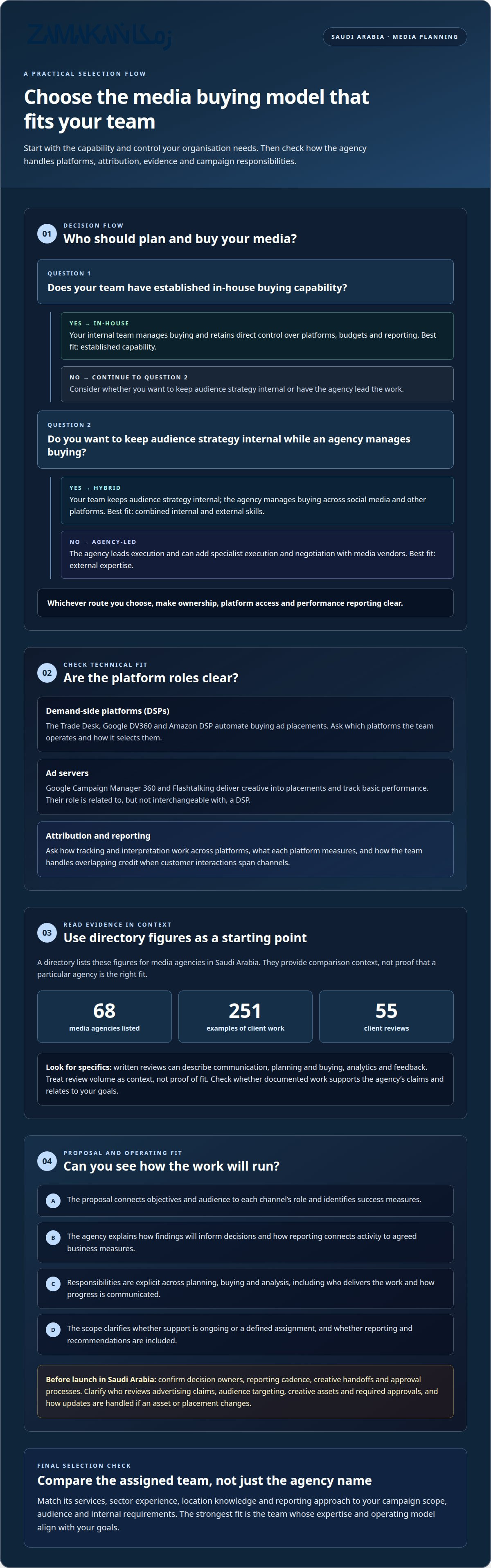
In Saudi Arabia, in-house buying gives your team direct control over platforms, budgets and reporting. An agency adds specialist execution and negotiation with media vendors. A hybrid model keeps audience strategy internal while an agency manages buying across social media and other platforms. A media planning agency comparison should assess which model fits your team’s skills, campaign scope and need for control.
Ask which programmatic platforms the team operates and how it selects them. The Trade Desk, Google DV360 and Amazon DSP are demand-side platforms, which automate buying ad placements. Google Campaign Manager 360 and Flashtalking are ad servers that deliver creative into placements and track basic performance. These roles are related, but not interchangeable. A media planning agency comparison can reveal whether the agency understands how both fit your campaign.
Attribution connects campaign activity to outcomes. Compare how an agency handles tracking, reporting and interpretation across platforms, especially when customer interactions span several channels. A clear approach explains what each platform measures and how the team handles overlapping credit.
Before selecting an agency, clarify the scope of work, deliverables and attribution rules in each proposal.
| Buying model | Control | Execution and negotiation | Best fit |
|---|---|---|---|
| In-house | Internal | Internal team | Established capability |
| Agency | Agency-led | Agency team | External expertise |
| Hybrid | Shared | Agreed responsibilities | Combined internal and external skills |
Choose the model that makes ownership, platform access and performance reporting clearest.
During selection and onboarding in Saudi Arabia, expect discovery, access and measurement alignment, followed by a documented plan and launch schedule. Confirm decision owners, reporting cadence, creative handoffs and approval processes. Use a media planning agency comparison to assess how clearly each prospective team defines these responsibilities.
In Saudi Arabia, assess agency expertise through evidence that connects past work to your business goals. A directory lists 68 media agencies, 251 examples of client work and 55 client reviews.
Ratings offer a quick signal, while written reviews can describe clients’ experiences with communication, planning and buying, analytics and feedback. Treat review volume as context, not proof of fit. Look for specific comments about reporting or responsiveness, then assess whether documented work supports those impressions. Client names add context only when the agency’s role and the work are clear.
Compare Saudi agencies by the work they cover, the logic behind their recommendations and the detail in their reports. A provider focused on media buying may offer a different scope from one that also handles strategy and performance analysis. Check whether its reporting connects activity to agreed business measures and explains how feedback informs subsequent planning. This distinction helps you assess whether services match your campaign requirements.
Assess a proposal against your objectives, audience and internal reporting needs. It should explain each recommended channel’s role, identify success measures and show how findings will inform decisions. A useful media planning agency comparison also considers whether the proposal reflects your sector and available evidence, rather than relying on broad claims. Review client examples for relevant experience, the agency’s stated responsibilities and results related to your goals.
Use this benchmark to guide questions, not as a standalone measure of quality or value. Ask what the proposed work includes, who will deliver it and how responsibilities will be allocated across planning, buying and analysis. Clarify whether the proposal covers ongoing support or a defined assignment, and whether reporting and recommendations are included.
When comparing proposals, assess the agency’s stated responsibilities and the evidence supporting its approach. Ask how the team will communicate progress, explain performance and respond when results differ from expectations. These details help you assess the working relationship alongside expertise, services and relevant client examples.
Related agency types serve different parts of advertising. A media agency plans and buys placements; a public relations agency shapes communication and relationships with stakeholders. Creative and design teams develop campaign concepts and assets, while digital marketing agencies may focus on search or social media. Some firms combine these disciplines, so compare what is integrated and what remains separate.
In Saudi Arabia, compliance should be part of campaign planning, not a final approval step. Clarify who reviews advertising claims, audience targeting, creative assets and required approvals before campaigns launch. Ask how updates are handled when an asset or placement changes. This process helps marketing teams coordinate responsibilities and reduce the risk of inconsistent messaging across platforms.
Global holding companies can bring several agency disciplines under one corporate group, employing hundreds of thousands of people worldwide. Major groups historically include large networks that offer access to varied capabilities through different corporate structures. When conducting a media planning agency comparison, remember that group scale may offer broad resources, but the most relevant comparison is always the specific team and expertise assigned to your work.
Creative and design work adds value when campaign ideas, brand assets and media placements support the same objective. A launch campaign, for example, needs creative suited to each chosen platform and a plan to reach its intended audience. Clarify who develops and approves assets, how revisions fit the workflow, and how performance feedback informs later placements. These responsibilities matter whether creative work sits with one agency or separate partners.
Media planners focus on audience insights, channel mix and budget allocation, while media buyers focus on pricing, inventory quality and vendor relationships. Establish responsibilities before work begins: ask who develops the channel mix and budget, and who evaluates inventory and vendor arrangements. Planning and buying need to coordinate so audience plans and purchasing decisions align. Clear ownership also helps teams discuss trade-offs without treating the functions as interchangeable. Compare how agencies assign these roles and share information during campaign decisions.
In Saudi Arabia, assess location by how well an agency can support your campaign footprint, rather than by its office address alone. A nationwide brief may require consistent coordination across several markets, while a campaign aimed at one city needs planning suited to that audience. Ask how the proposed team connects local audience research, channel choices and campaign optimization.
No single agency is the right fit for every business size or industry. For a smaller organisation, clear account ownership and focused planning may matter most; a larger one may need coordination across business units, products or regions. Compare the team’s relevant experience and working approach with your operating model, rather than relying on a general label such as “full service.”
Specialties should connect directly to your campaign objective. A retailer planning a seasonal promotion may prioritise audience reach and customer demand, while a sports organisation may focus on relevant fan audiences and event timing. These examples illustrate different planning needs, not guaranteed outcomes. Look for documented work in your sector and a clear explanation of how it informs the proposed approach.
Use three practical checks: match geographic coverage to the campaign’s intended reach, connect sector experience to your business model, and assess how recommendations support measurable optimization. Ask who will manage activity across locations and how local audience differences affect channel selection. A strategy driven by those factors gives you a more useful basis for comparing agency fit than location or specialty labels alone.
zamakan Agency may be a relevant next step when your team needs a clearer basis for selecting and managing media planning. Its Advisory service can frame the decision around business priorities, audiences and measurement needs. Its Media service brings planning and buying together, helping you assess whether a proposed approach fits your campaign objectives and internal capabilities.
This support is useful when recommendations feel disconnected from your goals, reporting needs are unclear, or internal teams need a shared direction. A focused discussion can clarify your expectations of an agency, which audiences matter and how campaign performance should inform decisions. This creates a practical foundation for assessing expertise, scope and fit.
Related priorities may call for different capabilities. SEO/SEM is relevant when search belongs in the wider marketing assessment, while Branding can align campaign direction with how your organisation presents itself. These capabilities can complement media planning without making every engagement the same. The right emphasis depends on your objectives, channel mix and the responsibilities you want a partner to support.
For a useful starting point, bring your campaign goals, audience priorities, existing measurement approach and key constraints to the conversation. These details help establish what needs attention and where agency expertise could contribute. zamakan Agency can discuss how Advisory, Media, SEO/SEM or Branding relates to your decision, without assuming every capability is needed. To discuss your media planning needs, contact zamakan Agency.
In Saudi Arabia, identify agencies by the channels your campaign needs, rather than assuming one provider covers every format equally. For a shortlist, separate required channels, then assess each agency’s relevant work and audience knowledge for those placements. A campaign combining digital and outdoor media, for example, may need different planning considerations from one focused on television or radio.
Ask who will work on your account, how the agency will coordinate with your internal team and what information it needs from you. Clarify who approves changes, how creative assets and campaign data move between teams, and how the agency handles delayed decisions. These questions reveal whether its working process fits your organisation’s governance and day-to-day capacity.
Risks include unclear deliverables, limited visibility into campaign activity and reporting that does not connect with your organisation’s records. Agree on reporting access and responsibilities before work begins. During reviews, compare agency reports with relevant platform records and your own business data. Document material changes to objectives or scope so later evaluations reflect what the campaign was asked to achieve.