Justifying a marketing budget to the board of directors starts with linking each proposed investment to a business objective and showing how progress will be measured. Present clear options, the outcomes each is intended to support, and the risks of reducing or delaying spend. This gives management and the board a practical basis for deciding where marketing can advance the organisation’s priorities in Saudi Arabia.
• Translate marketing metrics into business outcomes, such as revenue contribution, efficiency, and reduced risk.
• Present conservative, optimal, and aggressive investment options so decision-makers can weigh trade-offs.
• Link each proposed activity to the organisation’s priorities, target audience, and intended outcome.
• Build a clear board case around the decision needed, expected results, key risks, and how progress will be reviewed.
Build the proposal around business outcomes and the evidence leaders need to decide. For campaigns in Saudi Arabia, account for applicable local advertising and data requirements, and connect every investment to organisational priorities.
•
Map each activity to revenue, profit, efficiency, or risk reduction. For example, connect a lead-generation campaign to qualified opportunities and sales, not clicks alone. Explain forecast assumptions and name the leader responsible for each outcome. For Saudi organisations, include relevant compliance considerations in the plan. This turns a list of marketing tasks into a business case.
•
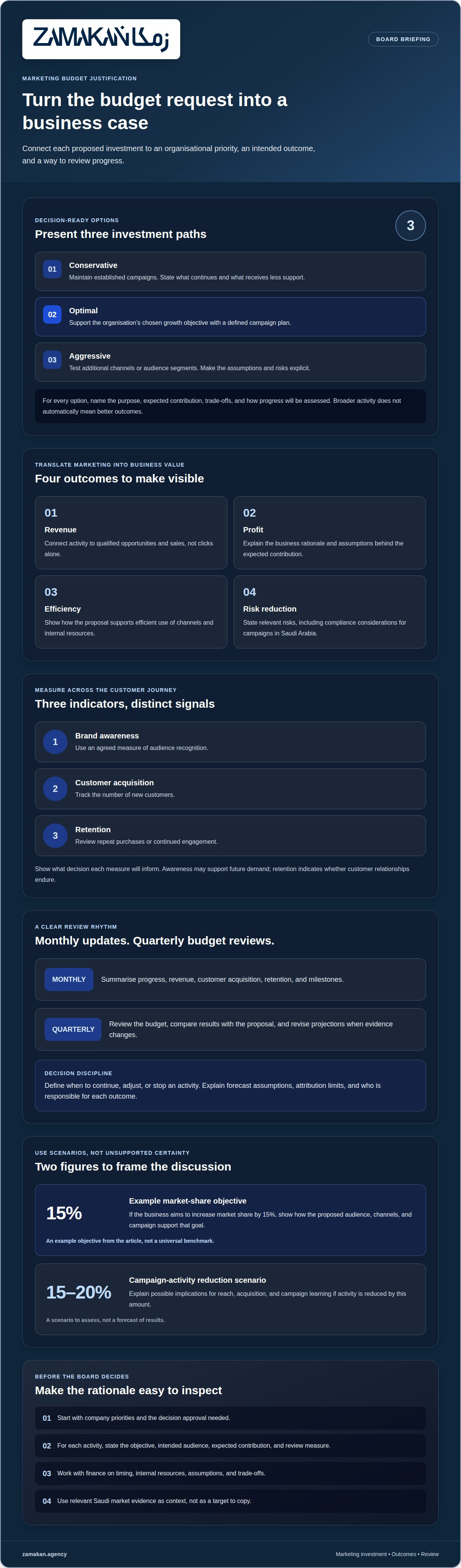
Choose indicators for distinct stages of the customer journey. Track brand awareness with an agreed recognition measure, customer acquisition through the number of new customers, and retention through repeat purchases or continued engagement. Present these measures together: awareness may support future demand, while retention indicates whether customer relationships endure. When justifying a marketing budget to the board of directors, show what decision each KPI will inform.
•
Compare repeat purchases and engagement over the customer relationship, using consistent periods and stated assumptions. This helps leaders assess whether a channel can support growth. The appropriate marketing budget percentage varies by industry and business model. For Saudi organisations, consider margins, growth objectives, competition, and customer behaviour rather than applying a universal benchmark. Explain attribution limits and the assumptions behind any growth projection.
•
Set review points, compare results with the proposal, and revise projections when evidence changes. Monthly progress summaries and quarterly budget reviews can track revenue, customer acquisition, retention, and milestones. Explain how a cut or underfunded campaign could affect reach, learning, or the ability to assess results. A disciplined approach to justifying a marketing budget to the board of directors also clarifies when to continue, adjust, or stop an activity.
Give decision-makers distinct options rather than one fixed request. For each, explain its purpose, assumptions, risks, and how the organisation will assess progress in Saudi Arabia.
•
Define conservative, optimal, and aggressive options around different business priorities. A conservative plan might maintain established campaigns; an optimal plan could support the organisation’s chosen growth objective; an aggressive plan could test additional channels or audience segments. For each, specify the campaigns included, expected contribution, and trade-offs. Do not imply that broader activity automatically leads to better outcomes.
•
Use relevant Saudi market evidence to frame the proposal, comparing organisations with similar sectors, growth stages, customer models, and objectives. Competitor activity may reveal shifts in channel priorities, but it does not determine what your business should do. Explain differences in margins, customer demand, and campaign goals before drawing comparisons. Treat benchmarks as context for a decision, not a target to copy.
• Assess the proposal and your position before presenting. State the approval needed, the evidence behind your estimates, and the assumptions that could change them. Directors considering a substantial proposal need to understand the channels involved, expected outcomes, risks, and review measures. Explain what each option enables and what the organisation may defer if it chooses a narrower approach.
• Frame marketing around commercial outcomes, then report progress against agreed milestones. Give investors and board members concise updates on actual results, campaign learning, and changes to projections. Monthly investor updates can summarise key metrics, while board reviews can connect performance with business goals. Include a scenario for a 15 to 20% reduction in campaign activity, explaining its implications for reach, acquisition, and campaign learning.
If you need support shaping campaign options and their business rationale, explore marketing planning guidance.
Start with the organisation’s priorities, then link each proposed activity to a measurable objective. This makes the strategy relevant to leaders and finance.
•
Identify the company’s short-term priorities, long-term strategy, and the concerns raised by the board and CEO. Then map each marketing activity to a specific objective. For example, if the business aims to increase market share by 15%, explain how the proposed audience, channels, and campaign support that goal. Avoid funding activity simply because competitors are doing it.
•
Develop the proposal with finance, not just for finance. Explain its business rationale, key assumptions, expected contribution, and the measure that will demonstrate progress. A CFO can help assess whether the timing, internal resources, and expected returns fit the organisation’s plans. Address trade-offs directly: identify which objective would receive less support if the board redirects resources elsewhere.
• Translate the strategy into a clear funding rationale. For each proposed channel or campaign, state the objective, intended audience, expected contribution, and review measure. If the plan supports customer acquisition, explain how it fits the company’s growth priorities and how results will shape future decisions. Keep the link from business goal to activity visible instead of presenting a disconnected list of marketing tasks.
• Prepare alternatives to support discussion with management. Show how different spending levels or channel choices would change the plan’s ability to meet its objectives. For example, distinguish activity supporting an immediate priority from work that builds longer-term demand. This helps leaders assess the proposal alongside other departmental priorities, rather than treating marketing as an isolated activity. Record the agreed objective and review criteria.
Make the board presentation a decision document, not a tour of marketing activity. Organise it around the approval needed, the outcomes sought, and how success will be measured.
• Open with the decision you need from the board and state it on the first slide. Then explain the business problem or opportunity, the recommended investment, and the consequences of delaying action. This structure lets directors understand what they need to decide before reviewing campaign details. Keep the proposal concise enough to support discussion, not just presentation.
• Connect each major outcome to a clear metric and measurement method. Separate observed results, such as completed sales, from estimates, such as projected contribution from brand activity. Explain assumptions behind estimates in plain language. If a metric cannot be linked directly to revenue, state what it indicates and how it will inform the next decision.
• Present risks alongside mitigation, then show how progress will be reported. Agree on success measures and review timing before approval. A practical rhythm combines monthly progress summaries with formal quarterly budget reviews. Include campaign milestones, actual results, changes in projections, and decisions required. This gives board members visibility without turning each update into an unfiltered channel report.
• Use a clear visual hierarchy and limit the board pack to relevant signals. Avoid dashboards with 25 charts; select the metrics that answer the board’s decision and show trends against agreed objectives. Explain any gap between expected and actual outcomes, what the team learned, and the adjustment proposed. This makes measurement useful for governance, rather than a retrospective display of activity.
• Prepare for scrutiny by knowing the assumptions behind every forecast and the evidence supporting each claim. If attribution is incomplete, explain which factors influence results and where estimates begin. Tie the next review to a specific decision, such as continuing, changing, or stopping an activity. For help shaping an accountable marketing proposal, discuss your board presentation.
zamakan Agency helps turn marketing priorities into a strategy with clear objectives, investment choices, and measures for board reporting. Its Advisory service can help clarify the business case, while Media planning connects channel choices to the audiences and outcomes your organisation seeks. SEO/SEM and Branding can also support proposals that need a stronger link between marketing activity and company goals when justifying marketing budget to board of directors.
Consider this support when internal teams need to align priorities, evidence, and investment assumptions before presenting a budget. The focus is a practical, accountable rationale, not a promised return. If you’re preparing a marketing budget proposal for management or the board, contact zamakan Agency to discuss how its advisory and marketing services can support your planning.
Turn your proposed direction into a decision the board can revisit as conditions change. Keep the business objective visible, make assumptions explicit, and use new campaign evidence to refine the plan. This gives marketing and finance a shared basis for deciding what to continue, adjust, or stop.
Justifying a marketing budget to the board of directors is not about defending every activity indefinitely. It is about showing how investment choices support organisational priorities and how learning will guide the next decision. Zamakan Agency’s Advisory, Media, and SEO/SEM services can help organisations shape that rationale and connect marketing plans with business goals.
Bring your priorities and current planning challenges into a conversation, then identify where a clearer strategy or measurement approach could help. Contact Zamakan Agency to discuss your marketing budget priorities and take the next step with greater clarity.
Organise the presentation so directors can follow the decision from rationale to oversight. Begin with the approval requested, then show the business opportunity, proposed investment logic, key assumptions, and how progress will be assessed. Keep supporting channel detail in an appendix. For example, include forecast methods and audience definitions there for directors who want to examine the underlying analysis.
A presentation focused mainly on channel activity leaves directors without a clear basis for deciding. Impressions, clicks, and campaign counts describe what marketing did, but not whether it addressed a business priority. A stronger case explains which decision those measures inform and what management should do if performance differs from expectations. This shifts the discussion from defending activity to governing investment.
Build credibility by separating evidence from assumptions and explaining how each forecast was formed. Consider a hypothetical subscription business: distinguish new sign-ups from customers who remain active, then show how both affect the commercial case. Clarify which outcomes marketing can influence and which depend on pricing, sales follow-up, or product experience. This gives directors a more realistic basis for evaluating the proposal.
Maintain accountability by assigning an owner to each agreed objective and recording decisions made during performance reviews. A shared log can capture the original assumption, current evidence, any change to the plan, and who approved it. This helps a new finance or marketing leader understand why a campaign continued or changed, rather than relying on an annual presentation to reconstruct the reasoning.
Show the link between marketing activity and business results, while being precise about attribution limits. Compare outcomes with a relevant baseline, account for factors such as promotions or seasonal demand, and explain the method used to assign contribution. If results are directional rather than causal, say so clearly. Transparent analysis is more useful to a CEO than a precise-looking return built on weak assumptions.
Use monthly progress summaries and formal quarterly reviews as a practical starting cadence. Tailor content to the decision cycle: routine updates can highlight movement against objectives, while board reviews can address material changes, risks, and choices requiring approval. Escalate sooner if results or market conditions call for a decision before the next scheduled review. Keep the reporting format consistent so trends remain easy to interpret.