Agencies can provide strategy, but the right fit depends on whether you need clearer direction, specialist execution, or both. A marketing consulting agency comparison should assess strategic capability alongside channel skills and engagement scope, because a strong plan creates value when it aligns with your business priorities and available resources. In Saudi Arabia, look beyond a service list to how a partner connects audience research, media planning, performance marketing, and measurement to your goals.
Choosing between expert advice and extra delivery capacity can be difficult when budgets, data, and internal teams are constrained. This comparison explains how consultants, agencies, and combined setups differ, what to assess in their expertise and working arrangements, and how to choose a model that suits your organisation’s needs. A long service list alone does not prove strategic value.
• Assess whether your main constraint is marketing direction or the capacity to execute an established plan.
• Match a provider’s skills to your business model, internal resources, and growth priorities, and watch for unclear roles or one-size-fits-all recommendations.
• Compare deliverables, implementation ownership, decision-making, and communication expectations before an engagement begins.
• Use the first month to align priorities and responsibilities; Zamakan Agency’s advisory, media, SEO/SEM, and branding capabilities may support the areas your team needs.
A marketing consulting agency comparison should test whether a provider connects strategy to execution. A clear strategy defines target audiences, a value proposition, priorities, and suitable channels. Ask how audience research informs those choices, then trace recommendations into campaign planning, advertising, creative work, content, and measurement. This shows whether strategic thinking can guide the work your team needs delivered.
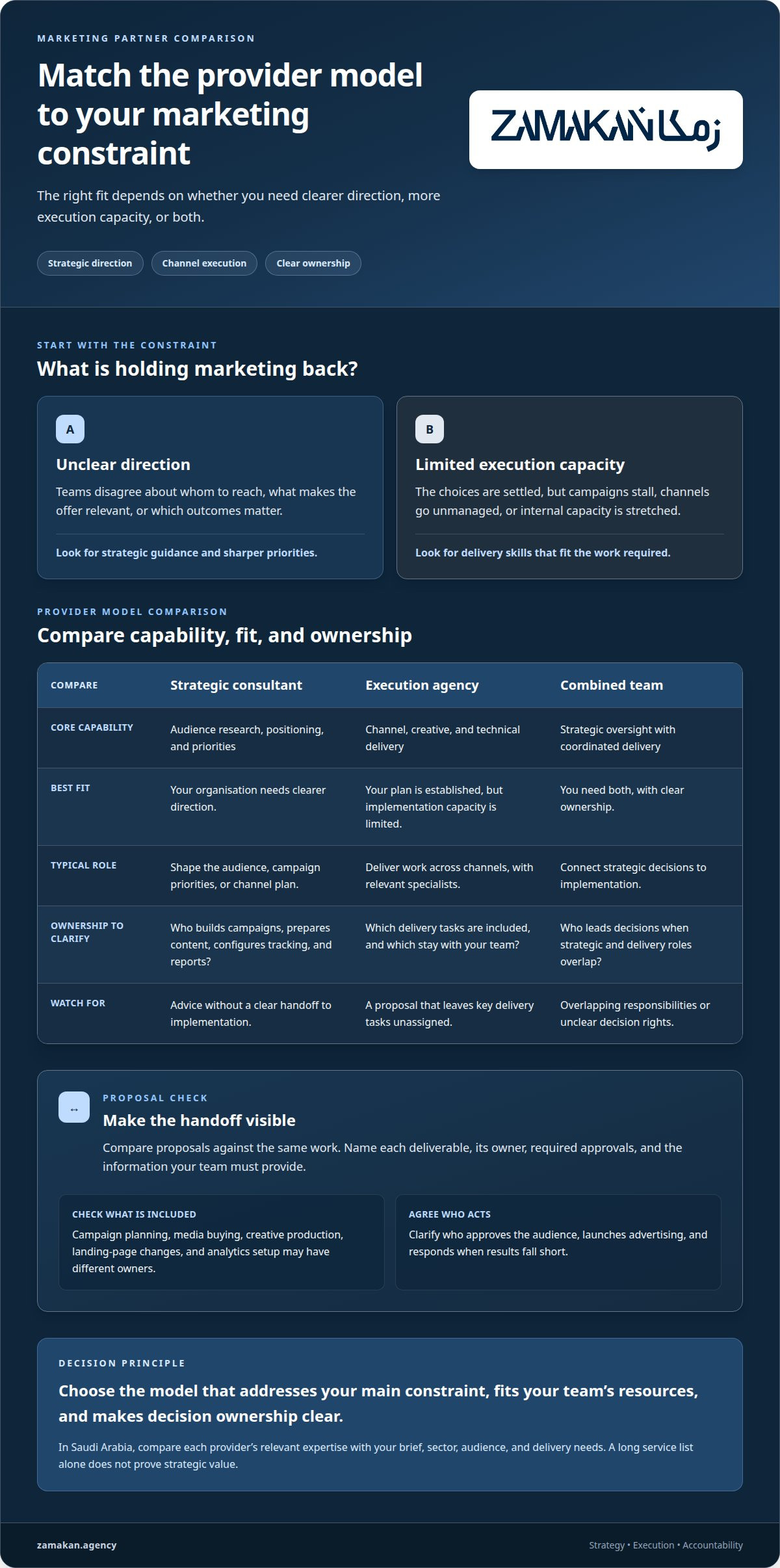
First identify whether your main constraint is strategy or execution. If teams disagree about whom to reach, what makes the offer relevant, or which outcomes matter, you need clearer direction. If those choices are settled but campaigns stall, channels go unmanaged, or internal capacity is stretched, execution is the issue.
| Provider option | Capability to assess | Best fit |
|---|---|---|
| Strategic consultant | Audience research, positioning, priorities | Unclear direction |
| Execution agency | Channel, creative, technical delivery | Limited implementation capacity |
| Combined team | Strategic oversight and coordinated delivery | Both needs, with clear ownership |
Choose the option that addresses your main constraint and makes decision ownership clear.
In Saudi Arabia, providers may focus on strategic advisory, channel-specific advertising, or campaign execution. Compare their capabilities with your brief, sector, audience, and delivery needs. The key is not the length of a service list, but whether the relevant expertise supports your objectives.
Assess the management and technical capabilities required to move from planning to delivery. Your team may need clear approval steps, consistent reporting, and an owner for campaign setup. Include these requirements in the scope so strategic recommendations connect to practical work.
To make the handoff clear, have the strategy team document the audience, value proposition, channel roles, and success measures. Then agree which execution team will turn that direction into work plans and reporting. This defines where strategic leadership ends and implementation begins.
A digital marketing agency may suit you when your business model is validated, ideal customer profiles are clear, and sales processes are stable. An agency can add capacity for paid media, search, or social campaigns. If you are still testing demand or refining the offer, prioritise strategic guidance before expanding campaign activity.
A fractional consultant may suit a business that needs senior direction without adding a full-time role. They can shape marketing strategy, set priorities, and coordinate internal staff or external specialists. Match the support to your stage: an early business may need to validate its audience, while an established organisation may need sharper measurement or closer sales and marketing alignment.
In a marketing consulting agency comparison, assess an agency, freelance consultant, and in-house team by ownership, expertise, and capacity. An agency can coordinate channel delivery, a freelancer can provide focused expertise, and an internal team retains day-to-day knowledge and control. For example, you could keep customer insights in-house while assigning campaign execution externally.
Agencies in Saudi Arabia may specialise in strategy, digital marketing, paid media, or search. Compare each provider’s focus with your objectives and delivery needs instead of relying on a broad service list. Also consider how its expertise fits your business model and team.
Be cautious of unclear responsibilities, vague descriptions of team experience, or claims that one tactic suits every business. A provider that recommends copying a competitor without examining your customers or offer is overlooking your context. Look for a clear connection between proposed work, decision owners, and measurable outcomes.
Map internal skills before choosing external support: identify who owns customer knowledge, approvals, and sales follow-up. Then assign remaining needs to the appropriate partner. If media execution is the constraint, explore media planning and buying support through zamakan Agency as one possible route.
Compare proposals by deliverables, decision rights, and implementation ownership. A campaign plan has limited value if nobody owns its launch, tracking, or follow-up.
A consultant’s engagement may focus on senior advice, such as refining the target audience, setting campaign priorities, or reviewing performance. Separate that advisory scope from implementation by identifying who builds campaigns, prepares content, configures tracking, and reports results. For example, a consultant may recommend a channel plan while your internal team handles execution. The proposal should make the handoff explicit, including required staff time and approvals.
Compare the work covered, not just the provider’s label. A consultant may direct strategy and assess results, while an agency may assign specialists to execute campaigns across channels. Some engagements combine both roles, but responsibilities can overlap unless someone leads decisions. List each deliverable, its owner, and the information your team must provide.
Check the exclusions that could affect delivery. A proposal might cover campaign planning but leave media buying, creative production, landing-page changes, or analytics setup to another team. Ask for a responsibility map: who approves the target audience, launches advertising, and acts when results fall short? This shows what your organisation must resource.
For a fair comparison, align proposals around the same campaign objective and reporting expectations. Record each provider’s outputs, your team’s inputs, implementation milestones, and decision owner. Then assess whether your leadership team has capacity for tasks outside the engagement. Clear boundaries reduce duplicated work and keep strategy connected to execution.
Use the first month to establish working rules, validate priorities, and agree how decisions move into delivery. For a business in Saudi Arabia, connect the engagement to a clear objective, such as improving qualified enquiries or aligning paid media with actual revenue.
Before work begins, document the scope, decision-makers, required access, reporting rhythm, and approval process. Agree how the team will handle changes to positioning or campaign priorities so new requests do not displace agreed work without discussion.
Share the current marketing strategy, audience information, campaign history, and business goals. Identify gaps in tracking or data access that could limit an early assessment.
Agree which audiences and channels matter first, and define the outcome each activity should support. For example, a paid media review may focus on lead quality rather than reach alone.
Name who supplies information, approves recommendations, implements changes, and reports results. Clarify where internal teams or other agencies contribute.
Schedule a regular meeting to assess findings, resolve blockers, and confirm next actions. Record decisions and owners so work continues between discussions.
A consultancy engagement can provide strategic direction, specialist advice, or ongoing oversight. Choose a model based on the decisions you need help making and the implementation capacity available internally. If a consultant recommends a campaign, establish who will brief, launch, monitor, and adjust it.
For onboarding, a Saudi business should define its goals, compare relevant expertise, agree the scope and responsibilities, then provide the access and context needed to begin. Adapt the plan to your organisation’s audience, channels, and measures.
Use a focused media planning discussion to align campaign priorities, audience choices, and working responsibilities.
Zamakan Agency helps organisations connect marketing direction with the capabilities needed to move priorities forward. Its ADVISORY, MEDIA, SEO/SEM, and BRANDING services may suit you once a comparison clarifies where you need support, whether in planning, search, media, or brand strategy.
ADVISORY can help when priorities compete, teams lack alignment, or your marketing strategy needs a clearer path to action. Zamakan Agency develops and implements tailored marketing strategies across industries, connecting business goals with the activities, audiences, and measures that guide marketing decisions.
Consider MEDIA when your challenge involves channel choices or media planning and buying. Zamakan Agency provides media planning and buying solutions to organise how campaigns reach intended audiences. This can clarify the relationship between campaign objectives, channel selection, and media execution.
SEO/SEM may suit you when search performance needs closer examination. Zamakan Agency provides technical and content audits to identify performance gaps and improve search visibility. The findings can clarify which technical or content improvements deserve attention.
BRANDING can help when your campaigns or corporate communications need a more consistent expression. Zamakan Agency develops, audits, and executes branding concepts for campaigns and corporate communication, supporting clearer communication across campaign materials and organisational touchpoints.
These capabilities address different needs, so you do not need to adopt every service. If your main constraint is direction, start with the strategic question. If your plan is clear, focus on the channel or search issue limiting implementation. If your brand expression feels disconnected, consider branding in that context.
Contact Zamakan Agency to discuss which capabilities fit your organisation’s priorities.
A clear partner decision should create momentum, not more uncertainty. Use your marketing consulting agency comparison as a practical reference, then decide which capability your organisation needs to strengthen. That choice can help your team allocate attention, align stakeholders, and turn priorities into accountable work.
Zamakan Agency brings ADVISORY, MEDIA, and SEO/SEM capabilities to organisations seeking support with marketing decisions and delivery. The right starting point depends on your business objective, internal resources, and the challenge you need to address. A focused discussion can help clarify the fit and define the next engagement.
Contact Zamakan Agency to discuss your needs and identify a considered next step for your organisation. With the right direction and clear ownership, your team can move forward with greater purpose.
Yes. An agency can contribute to strategy as well as campaign delivery, depending on its scope and expertise. For example, a team might assess a proposed audience and recommend channels that support your organisation’s objectives before planning campaigns. Ask how recommendations connect to execution and whether the people shaping direction remain involved when delivery decisions arise.
Founders should assess whether a partner’s strengths match the business’s current priorities and decision-making needs. A business testing its offer may need help validating audience assumptions, while one with steady demand may need specialist channel support. Consider who will make decisions, what expertise exists internally, and whether the proposed work addresses the immediate constraint.
Look for examples that resemble your challenge, audience, or marketing channel, then examine the agency’s actual role. Ask about the starting conditions, activities delivered, and how results were measured. An outcome is more useful when its timeframe, attribution method, and other contributing factors are clear, rather than presented without context.
Ask who will lead the work, who will deliver it, and which decisions require your approval. Clarify the expected outputs, reporting format, communication cadence, and information your team must provide. You can also ask how the provider responds when early findings challenge the original plan. Specific answers help show whether the working relationship suits your organisation.
Review the written scope, deliverable acceptance process, renewal and cancellation provisions, confidentiality, data handling, and ownership of completed work. A service-level agreement should define communication channels, response expectations, escalation steps, and reporting commitments. Confirm how either party can address missed dependencies or changing priorities, and seek qualified legal advice if contract language is unclear.