
A marketing strategy delivers value when clear priorities become coordinated work, accountable ownership, measurable outcomes and regular adjustments. Effective marketing strategy implementation connects the plan to day-to-day decisions, rather than treating approval as the finish line.
A well-designed strategy should guide the team, but execution can stall when resources are stretched, priorities compete, data is unreliable or teams work in isolation. The answer is not simply to add activity. Make the work manageable, assign responsibility and establish a clear way to respond when results or conditions change.
This guide explains common implementation challenges and how to move from strategy to delivery through practical project management, shared accountability, risk planning and regular optimisation. Learn how to set priorities, track progress and adjust marketing activity with purpose, including in Saudi Arabia’s changing business environment.
• Choose marketing channels around audience behaviour and business goals, then coordinate them so each supports a consistent customer journey.
• Turn priorities into owned projects with clear responsibilities, milestones and plans for addressing delivery risks.
• Review progress quarterly and adjust activity based on meaningful performance signals, not assumptions alone.
• Connect strategic goals to practical initiatives and timelines, and align media planning, advisory or SEO/SEM support with the gaps your team needs to address.
Execution becomes difficult when channel choices reflect habit rather than audience needs and business goals. For campaigns in Saudi Arabia, include consent, data handling, advertising claims and electronic communications in the approval process. This helps teams identify compliance questions before campaign materials go live.
•
Select channels by mapping each audience segment to its needs, habits and stage in the customer journey. For example, a hypothetical Saudi retailer might use search to reach people comparing products and social media to support discovery. Assess each option using audience research, campaign insights and team capacity. Avoid spreading resources across channels without a clear purpose or a practical way to assess effectiveness. Omnichannel marketing coordinates selected channels around a connected customer experience. It does not require a brand to appear everywhere.
•
Coordinate campaign timing, audience, core message and next action in one shared plan. In a hypothetical product launch, social media could introduce an offer while search advertising reaches people actively looking for that product. Assign an owner to align schedules, approvals and tracking across teams. Keep messages consistent without making them identical, and give customers a clear next step on each channel. This helps prevent conflicting claims, duplicated effort and gaps between campaign touchpoints and follow-up.
• Adapt content to each channel’s format and audience behaviour while preserving the campaign’s central promise. A social post, search advertisement and landing page should not use identical copy. Tailor the length, detail and call to action to each context. For example, a hypothetical social post could introduce a benefit, while its landing page explains the offer and next step. Set production responsibilities and approval stages before launch so each asset supports the same campaign outcomes.
Use a shared project board, campaign calendar and analytics dashboard to coordinate delivery. These tools clarify ownership, deadlines and performance indicators, while a 90-day action plan turns priorities into manageable work.
•
Build a campaign calendar linking every activity to a business objective, audience and delivery date. Include content formats, approval stages, dependencies and the person responsible for each task. For example, a product launch plan might sequence landing-page updates, search ads and social posts. Review workload before setting deadlines, and do not schedule content without a clear role in the campaign.
•
Break the strategy into a 90-day action plan with milestones, owners and measurable outcomes. Start by listing the work required, then sequence tasks according to dependencies and available resources. Set an indicator for each milestone, such as completed campaign setup or qualified enquiries. Review progress at planned intervals, and revise the next actions when results or operating conditions change.
•
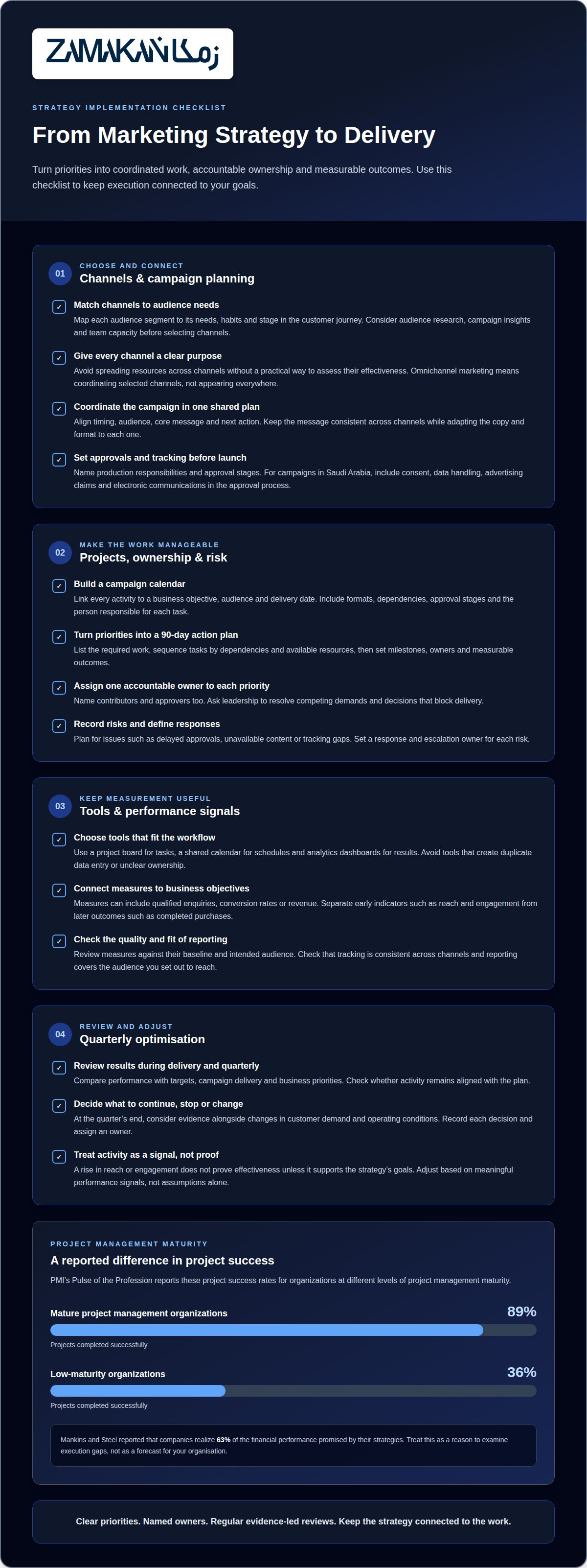
Assign one accountable owner to every priority, while naming contributors and approvers. Ask leadership to resolve competing demands and decisions that block delivery. Record risks such as delayed approvals, unavailable content or tracking gaps, then define a response and escalation owner for each. PMI’s Pulse of the Profession reports that mature project management organizations complete 89% of projects successfully, compared with 36% in low-maturity organizations.
•
Select tools that match the team’s workflow: a project board for tasks, a shared calendar for schedules and analytics dashboards for results. Connect reporting to campaign indicators, so teams can identify delays and assess outcomes in one review. Avoid adding software that creates duplicate data entry or unclear ownership. If planning needs an outside perspective, explore marketing strategy support.
Use regular strategy reviews to connect the organisation’s vision to measurable objectives. Compare results with targets, then adjust activity to support the outcomes that matter to the business.
•
Choose performance measures that connect campaign activity to business objectives, such as qualified enquiries, conversion rates or revenue. Separate early indicators, including reach and engagement, from later outcomes, such as completed purchases. Review each measure against its baseline and intended audience. A rise in activity is not proof of effectiveness unless it supports the strategy’s goals.
•
Review campaign results during delivery, then hold a structured quarterly assessment. Check whether tracking is consistent across channels, whether reporting covers the intended audience, and whether delivery remains aligned with the plan. Mankins and Steel reported that companies realize 63% of the financial performance promised by their strategies. Use that finding as a reason to examine execution gaps, not as a forecast for your organisation.
Use a 90-day framework to organise work into phases, with clear objectives, measurable outcomes and progress tracking. Review the evidence at the quarter’s end alongside changes in customer demand, campaign delivery and business priorities. Record which activity should continue, stop or change, and assign an owner to each decision. This keeps the vision connected to operational choices.
Use days 61-90 for optimisation and scale, comparing channel performance and audience response before shifting effort. For example, if one campaign attracts attention but few qualified enquiries, examine its message, landing page and conversion path before expanding it. Stanford Graduate School of Business research on operational excellence reports systematic performance monitoring frameworks help companies achieve 40% faster time-to-market and 35% better resource efficiency. Treat these figures as research findings, not promised outcomes.
Set a clear direction and measurable objectives, assign initiatives and owners, then execute and refine the work using results. Formulation defines the choices; implementation turns them into action.
•
Start with a business goal, then define your audience, positioning and value proposition. A hypothetical Saudi retailer seeking online growth might focus on first-time buyers in selected product categories rather than target everyone. Use audience research and performance insights to test assumptions. State what the strategy will not pursue, too. Clear boundaries protect focus during development and prevent new requests from diluting direction.
•
Translate the approved strategy into initiatives, owners, dependencies and indicators. Connect each activity to an objective. A category launch, for example, could pair awareness activity with a path to product consideration. Map required inputs and approvals before setting dates, and name a decision-maker for trade-offs. This framework turns intent into executable work and gives teams a clear route for raising delays or conflicting priorities.
• Test the framework against team capacity and audience needs. A national Saudi campaign may require different timing or language choices for different customer segments. Check that the message, selected channels and customer journey support the same objective. Keep assumptions visible and define what evidence would prompt a change. A strong strategy provides direction without treating the original plan as fixed.
• Establish a learning loop before launch. Record each objective’s baseline, reporting source and review owner, then define whether results call for continuing, revising or stopping an activity. McKinsey & Company reported that less than one third of strategy executions were viewed as successful. Treat execution as part of strategy development, not a handoff after approval. Link each review to a decision that keeps activity aligned with growth priorities.
If strategic choices need to become coordinated media activity, align your plan with media activity.
zamakan Agency can help turn your strategy into a coordinated media plan or bring clearer alignment to channel choices, audience priorities and performance measures. Its Media Planning & Buying Strategy connects business objectives with audience and channel decisions, helping your team structure activity around defined outcomes.
Turn to zamakan when your team needs strategic direction, media planning and buying expertise, or a clearer view of how SEO/SEM fits the wider plan. The right scope depends on your objectives, audience and existing resources. A focused discussion can identify how advisory, media or SEO/SEM support can serve your implementation needs.
Contact zamakan Agency to discuss your marketing strategy and next steps.
Choose a strategic priority and give it a clear path into the organisation. When a team knows what it is advancing, who owns the work and what evidence will guide the next decision, marketing strategy implementation becomes a practical discipline, not a plan set apart from daily operations.
Some organisations need sharper strategic direction; others need media planning or stronger search visibility. Zamakan Agency works across Advisory, Media and SEO/SEM, helping connect those needs to the decisions your organisation must make. Start with the challenge currently limiting progress, rather than adding activity for its own sake.
Contact Zamakan Agency to discuss the priorities you want to move forward. A clear next decision can set meaningful progress in motion.
Marketing strategy implementation is difficult because strategic choices must hold up against competing priorities, handoffs and changing assumptions. A sales team may define a qualified lead differently from marketing, making campaign results hard to interpret. Leaders can reduce this friction by agreeing on shared definitions, decision rights and escalation routes before work begins. This alignment helps teams act on the same evidence instead of debating what success means.
No single return on investment (ROI) applies to every campaign. Assess ROI by comparing the incremental value attributable to marketing with the outcomes achieved, and state which results the calculation includes. For example, a campaign may generate enquiries that convert later, so judging it only on immediate sales can understate its contribution. Treat ROI as an evidence-based assessment, not a guaranteed forecast.
Translate each objective into a deliverable, an owner and a decision rule. If the aim is to increase qualified product enquiries, define what qualifies, identify the customer touchpoints involved and agree how sales will record follow-up. Then document dependencies, such as product information or approval from another team. This makes the objective observable in daily work and clarifies what to change if the intended result does not emerge.
Set priorities according to strategic objectives, expected audience impact and the team’s ability to deliver. Assess each activity against the same objective and assumptions. Include staff capacity, approvals and analytical support in the plan. An activity without the time or reporting capability needed for execution can weaken the strategy.
Choose key performance indicators (KPIs) that show whether the strategy is being delivered and contributing to business results. Pair operational measures, such as on-time completion of agreed initiatives, with outcomes suited to the goal, such as qualified pipeline or repeat-purchase rate. Define each KPI’s calculation, data source and review owner to prevent teams from reporting conflicting interpretations of the same result.
Choose channels by matching audience needs and decision context with the role each channel can play. For a considered business purchase, assess whether the channel supports detailed evaluation, reaches relevant decision-makers and gives your team a practical way to measure response. Compare channels against these criteria, then test the strongest fit. Do not select a channel solely because it is familiar or popular.