The right approach to gtm strategy consulting in Saudi Arabia depends on how much market validation, local relationship-building and implementation support your organisation needs. A focused advisory engagement can help define the market opportunity and route to customers, while a broader partnership can connect strategy with audience research, media planning and execution. This guide explains how to assess engagement models and timelines, identify the work that should shape a proposal, and account for local relationships when planning market entry, so you can make a sound decision without treating every Saudi opportunity as the same.
• Match the consulting approach to the decision you need to make, and define deliverables before agreeing on an engagement model.
• Assess timelines by the work involved, from market validation and planning to implementation and measurement.
• Build local relationships into market entry planning, alongside the route to customers and the practical steps needed to launch.
• Shape your go-to-market plan around the customer groups and regional differences that matter to your offer, rather than relying on one nationwide assumption.
In Saudi Arabia, implementation should connect market-entry decisions to accountable owners, partners and customer-facing activity. Start by mapping who influences each decision, from distribution partners to your sales and marketing teams, and clarify who is responsible for moving each action forward.
A useful methodology turns strategic findings into assigned actions, decision points and feedback loops. Ask how the work moves from market and audience analysis to a clear go-to-market strategy. For example, a hypothetical launch could test its positioning with a selected customer group before expanding media activity. The plan should also account for the relevant decision-makers, whether public-sector stakeholders or private buyers.
An implementation roadmap sets out actions, owners, dependencies and review points. Define KPIs, or key performance indicators, to track measurable outcomes such as qualified enquiries, and use OKRs, or objectives and key results, to connect those measures to broader goals. For a nationwide launch, the roadmap might schedule audience research, channel planning and campaign testing after approvals. Review results at agreed points and adjust actions when the evidence changes.
Local relationships can help clarify access, trust and operational responsibilities. Before launch, map each partner’s role, decision authority, customer access and reporting expectations. A national plan may still need to account for different customer groups and distribution routes. Record those assumptions in the implementation plan rather than treating one relationship as proof of demand across the country.
Connect the business model to the customer journey in one working plan. Define the target segment, value proposition, distribution route and service responsibilities, then assign internal owners for marketing, sales and customer service. This can expose gaps early, such as generating campaign interest before the team has agreed how to handle enquiries.
Core systems also need clear ownership. Map how lead records, order management, reporting and customer service workflows support the chosen route to market. For example, agree which team records a qualified enquiry and how campaign results reach decision-makers. Tie system changes to launch requirements, and avoid adding processes that do not support a defined KPI or responsibility.
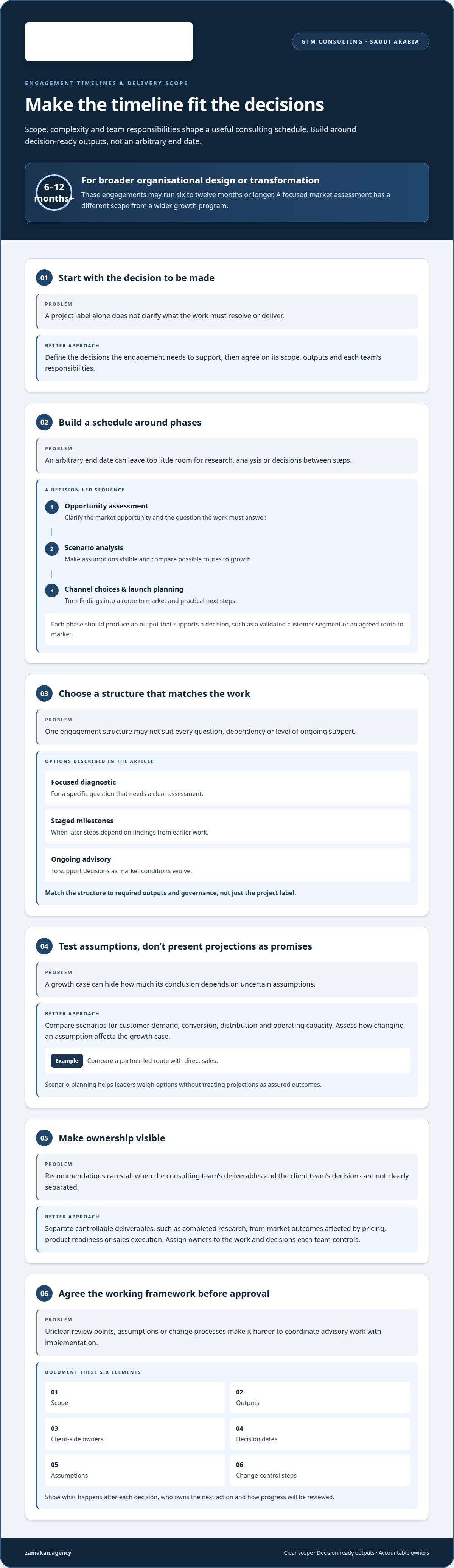
In Saudi Arabia, the scope and complexity of the decisions shape an engagement’s timeline and deliverables. A focused market assessment differs from a growth program that also involves operating-model changes, financial modelling and implementation planning. Before agreeing on outputs and review points, define the decisions the work needs to support and the responsibilities of each team.
Build the schedule around phases, not an arbitrary end date. A market-entry program might move from opportunity assessment to scenario analysis, channel choices and launch planning. Each phase should produce an output that supports a decision, such as a validated customer segment or an agreed route to market. Broader organisational design and transformation engagements may run six to twelve months or longer.
Structure consulting work around the required scope, milestones and level of ongoing support. A focused diagnostic can suit a specific question; staged milestones may fit when later steps depend on earlier findings. Ongoing advisory can support decisions as market conditions evolve. Match the engagement structure to the required outputs and governance, not just the project label.
Financial modelling should make assumptions visible. Compare scenarios for customer demand, conversion, distribution and operating capacity, then assess how changing an assumption affects the growth case. For example, a hypothetical model could compare a partner-led route with direct sales. Scenario planning helps leaders weigh options without presenting projections as assured outcomes.
Assign responsibilities clearly. Agree which outputs the consulting team will deliver and which decisions or actions the client team owns. Separate controllable deliverables, such as completed research, from market outcomes affected by pricing, product readiness or sales execution. This helps both teams understand their roles and coordinate the work.
Before approval, document the framework: scope, outputs, client-side owners, decision dates, assumptions, and change-control steps. In the Kingdom, this structure helps connect advisory recommendations with national priorities and sector-specific infrastructure needs. A practical program should show what happens after each decision, who owns the next action, and how progress will be reviewed.
For international organisations, Saudi market entry should connect corporate strategy with local customer needs and operational capacity. A sound plan brings market evidence, a clear direction and practical launch decisions together.
Assess customer demand, alternatives, access, and capabilities before committing to entry. Competitive conditions shifted after the January 2024 regional headquarters mandate, making positioning and routes to customers relevant considerations for international organizations. Key risks include weak demand validation, unclear differentiation, partner dependence, and gaps between planned growth and delivery capacity. Test each risk against a specific customer segment and business model. A sector-by-sector comparison can reveal whether the offer meets a distinct need or faces established alternatives.
Market-entry advisory connects corporate vision to target customers, value proposition, distribution, marketing channels, and launch sequence. Vision 2030 frames Saudi Arabia’s economic diversification and modernization; your plan still needs to show how the offer meets a defined customer need. Set prices by assessing customer value, competing alternatives, delivery costs, and channel economics, then test the proposed position with target buyers. Avoid assuming one price suits every segment. Assign owners to launch decisions and connect research findings to practical actions. Industry requirements and the sales route should shape the plan.
Go-to-market strategies vary by industry because buyers, decision-makers and routes to market differ. A hypothetical enterprise technology launch may require stakeholder alignment and a longer sales process, while a consumer product may depend more on availability, brand awareness and repeat purchase. Build the plan around the customer journey and buying process rather than applying one template across sectors.
Within a nationwide plan, customer needs and distribution access can vary by segment and channel. Identify differences through audience research and partner insight, then test the offer with the intended group. Common launch risks include untested assumptions, unclear ownership and a mismatch between demand and delivery capacity. Develop a phased entry plan, measure the response and expand when the evidence supports the next step.
Customer behaviour and regional differences can affect your audience, offer, channel choices and launch sequence. Build the plan from evidence rather than assuming there is one nationwide customer profile. Start by separating customer groups by need, purchasing role and preferred route to market. For example, compare enterprise buyers with individual consumers, then test whether each group responds to the same value proposition.
Use Riyadh, Jeddah and Dammam as distinct research locations, not as stand-ins for every Saudi customer. Compare demand, distribution access and media response in each place before setting national priorities. A product with broad online availability may need a different activation approach from a service that depends on in-person sales. Record the assumptions behind each location-level decision.
Language, messaging and timing also deserve deliberate testing. Review how each audience describes its needs, which benefits it values and what information supports its purchase decision. For a campaign planned around Ramadan, assess whether the timing and message fit the target segment and sales cycle. Use interviews, customer-service feedback and campaign results to refine the plan instead of treating cultural context as a fixed formula.
Turn findings into a practical sequence: define segments, test the offer, select channels and compare responses by location. Track qualified enquiries, conversion and repeat purchases where those measures fit the business model. If Riyadh generates awareness while Jeddah produces stronger purchase intent, adjust channel roles and follow-up accordingly. Keep measurement consistent so comparisons inform decisions rather than reflect different tracking methods.
A region-aware media plan should connect audience selection, channel choices, message, and measurement. Shape a region-aware media plan around the customer groups and locations your strategy prioritizes.
Zamakan Agency can help connect your Saudi market-entry priorities with audience strategy and media decisions. Its advisory work supports strategic marketing direction, while media planning and buying aligns target groups, channels, campaign objectives and measurement. SEO/SEM can also support search visibility and demand capture as part of a broader go-to-market strategy.
Bring a defined business objective, priority customer groups and any existing audience or campaign data to the discussion. This gives the work a practical starting point and connects media activity with your wider go-to-market plan. The approach can reflect your sector, national priorities and internal resources.
If you’re ready to align your market-entry priorities with a media plan, contact Zamakan Agency.
Connect the market-entry decision to the people responsible for carrying it forward. Set an executive sponsor, agree who owns customer insight and channel decisions, and establish a review rhythm that lets the team respond to evidence. gtm strategy consulting in Saudi Arabia can bring these choices into a shared working direction while keeping assumptions visible as the market develops.
Zamakan Agency’s ADVISORY, MEDIA and SEO/SEM capabilities support organisations aligning strategic priorities with media planning and search activity. The right starting point depends on the decision your team needs to make and the work already underway. Ground the first discussion in your target audience, business objective and immediate planning priorities.
Start a conversation with Zamakan Agency about your next market-entry decision. With clear ownership and a learning-led plan, your team can move forward with purpose.
It helps you translate a business objective into a practical plan for reaching customers in Saudi Arabia. Work can cover market and audience analysis, positioning, channel choices, launch sequencing, and performance measures. For example, a B2B company might need to clarify its target accounts and sales route, while a consumer brand may prioritize audience segmentation and media planning. The scope should match the decisions your team needs to make.
Zamakan Agency provides ADVISORY, MEDIA and SEO/SEM services relevant to go-to-market planning. Its advisory work supports marketing direction, while media planning and buying connects audience priorities with channel activity. SEO/SEM supports search visibility. As you define the engagement, focus on the expertise needed for your decision, such as market positioning, media choices or search demand, and agree on the intended outputs.
Start by defining the business objective and the customer group you intend to serve. Then assess the offer, alternatives, distribution route and channels that can reach that audience. For a hypothetical software launch, you could validate needs with target organisations before setting a lead-generation plan. Assign marketing and sales owners, establish progress measures, and use customer and campaign feedback to refine the next phase.
Effective approaches focus on a specific customer need and a viable route to reach that customer. A hypothetical international food brand could test demand through selected retail partners before expanding distribution. A business software company might first focus on a defined group of organisations and adapt its sales materials to their buying process. In both cases, staged investment and clear measures help teams learn before widening the launch.