
Market analysis is valuable when it changes a decision, not when it adds another report to the pile. For market analysis for marketing strategy, examine market size, trends, competitors, customer segments, and buying behaviour to see where the strongest opportunities lie. In Saudi Arabia, these insights help businesses shape marketing around the people they want to reach and the conditions that influence their choices.
Audience segmentation is a practical starting point. Grouping potential customers by factors such as location, needs, behaviour and motivations can reveal which segments are most relevant, what problems they want solved and how they prefer to engage. Research from surveys, interviews, customer data and social media analytics can then test those assumptions and bring sharper detail to the picture.
This guide explains what market analysis covers, how to identify and research your audience, and how to turn findings into clearer marketing decisions. It also shows how a disciplined analysis can help you prioritize opportunities, refine positioning, and reduce avoidable risk before committing resources.
• Map competitors’ offers, positioning, pricing, and customer sentiment to uncover a meaningful point of difference.
• Prioritize audience segments by their needs, behaviours, and fit with your business goals.
• Combine customer feedback and available data to test assumptions and identify unmet needs.
• Use market insights to focus investment, refine positioning, and make more confident marketing decisions.
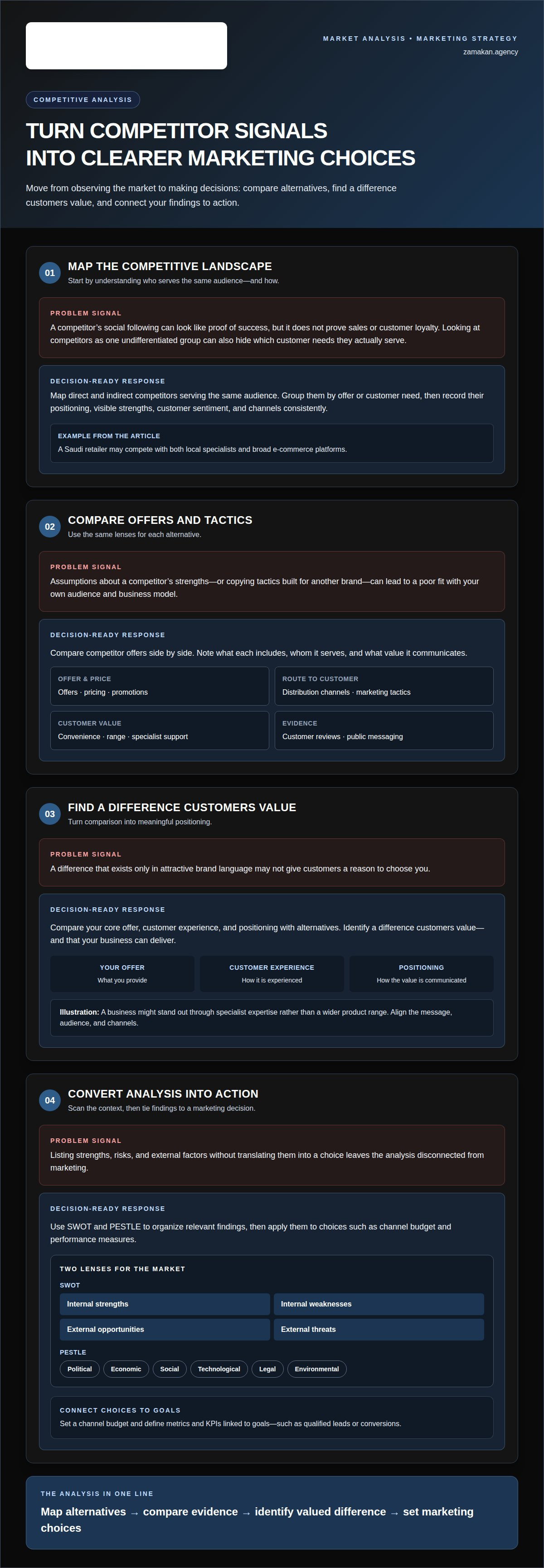
Market analysis evaluates a market’s size, customers, purchasing behaviour, trends, and competitors to guide decisions. For market analysis for marketing strategy, the competitive landscape reveals where an offer can earn attention and establish distinct positioning.
•
Map direct and indirect competitors serving the same audience, then group them by offer or customer need. Compare their positioning, visible strengths, customer sentiment, and channels. For example, a Saudi retailer may compete with local specialists and broad e-commerce platforms. Record evidence consistently, and do not treat a competitor’s social following as proof of sales or customer loyalty.
•
Compare competitor offers, pricing, promotions, distribution channels, and marketing tactics side by side. Note what each offer includes, whom it serves, and the value it communicates, such as convenience, range, or specialist support. Assess strengths using customer reviews and public messaging rather than assumptions. This comparison can reveal gaps without encouraging you to copy tactics designed for another brand’s audience or business model.
•
Turn competitor findings into an advantage your marketing can communicate and deliver. Compare your core offer, customer experience, and positioning with alternatives, then identify a difference customers value. For example, a business might stand out through specialist expertise rather than a wider product range. Align the message, audience, and channels so differentiation leads to action, not just attractive brand language.
•
Use SWOT to assess internal strengths and weaknesses alongside external opportunities and threats. Apply PESTLE to scan political, economic, social, technological, legal, and environmental factors that could affect demand or marketing choices. Translate relevant findings into actions instead of listing factors without a decision. Set a channel budget, then define metrics and KPIs linked to goals, such as qualified leads or conversions.
Define your audience before choosing channels or shaping campaign messages. A useful segmentation analysis connects customer needs and purchasing behaviour to a clear marketing decision.
•
Identify the people most likely to need the offer, then describe the problem they want solved. Set clear boundaries using geography, customer needs, and buying context. For example, a Saudi business could distinguish customers in Riyadh seeking convenient delivery from buyers elsewhere prioritizing specialist advice. Assess whether each group has meaningful demand and fits the business objective. Avoid defining the target so broadly that one message cannot speak to its needs.
•
Group potential customers by relevant demographic, geographic, psychographic, and behavioural characteristics. Demographics may include age or household composition, while geography can distinguish customers in different areas. Psychographics describe motivations and preferences, such as valuing convenience or expertise. Combine characteristics only when they explain a meaningful difference in needs. A segment should guide distinct positioning or channel choices, not just lengthen an audience description.
•
Compare how customer groups discover, evaluate, and purchase an offer. Examine buying habits, preferred channels, decision triggers, and the problems customers face in daily life. For example, one segment may act after a seasonal need arises, while another researches alternatives before deciding. These patterns help assess which groups are most relevant and where marketing efforts should focus. Use the resulting segments to tailor social content and messages; a focused social media strategy can align communication with each group’s interests.
In Saudi Arabia, combine direct customer feedback with business records and digital signals to inform marketing decisions. Start with a defined research objective, then compare what each source reveals about customer needs and behaviour.
No single channel works best for every Saudi audience. Assess search, social media, and other relevant channels against the preferences of your target segment and the campaign objective. Use engagement and conversion data to guide decisions and refine your channel mix.
In Saudi Arabia, account for applicable local requirements governing advertising and personal-data use. Give research a clear purpose, use transparent data practices, and do not rely on another country’s rules as a substitute for local requirements.
Outdated or biased research can misrepresent demand and lead to poor decisions. Look for narrow survey participation, leading questions, and old CRM records, then compare findings across sources.
•
Start with a specific question, such as what prevents a customer from completing an enquiry. Use surveys or interviews to gather stated needs, CRM records to review recorded interactions, and social media analytics to understand engagement. Compare the evidence rather than treating one source as the full picture. Reviews of competing brands can also reveal recurring questions and unmet needs.
For example, if survey responses point to uncertainty about an offer, compare that feedback with enquiry patterns and comments on relevant social channels. Note where the evidence agrees or differs before drawing conclusions about the wider target market.
•
Assess the customer problem, purchase triggers, alternatives considered, and factors that shape willingness to pay. Interpret stated price preferences alongside purchasing behaviour, competitor offers, and perceived value. Survey responses provide useful evidence, but do not show on their own what a customer will choose in a real purchase.
Use these findings to decide which needs your content should address. For instance, recurring questions about product suitability can inform explanatory content, while feedback about service expectations can help tailor messaging. Keep conclusions tied to the source and segment they represent.
Market analysis creates value when insights change priorities and actions. In Saudi Arabia, connect market dynamics to decisions, then track whether those decisions remain relevant.
Compare customer demand, market trends, and business capabilities before committing resources. For example, a Saudi business considering expansion can assess customer interest alongside competitor presence and potential barriers. This helps distinguish an attractive opportunity from one that does not fit the company’s strengths. Record the evidence behind each priority so leaders can explain why one direction comes first.
Identify assumptions that could undermine a launch or investment, including changes in purchasing behaviour, new technologies, economic shifts, or regulatory requirements. Assess each factor’s likely impact on the decision, then decide what evidence would prompt a change of plan. This approach cannot remove uncertainty, but it makes risks visible early enough to adjust positioning, timing, or resource allocation.
Use customer insights to refine what the business offers and how it communicates value. If research shows that a segment prioritizes convenience over broad choice, marketing can emphasize that benefit rather than rely on generic claims. Connect the insight to a specific action, such as adjusting content themes, channel priorities, or positioning. Then monitor customer response to see whether the change addresses the need.
Treat analysis as an ongoing input, not a report filed after planning. Review performance alongside market trends, competitor activity, and customer feedback; investigate changes before they become planning assumptions. In annual budgeting, these findings can help leaders prioritize investments and focus marketing efforts where they have a clearer rationale. For stronger strategic alignment, develop a market-informed marketing strategy around your business goals.
zamakan Agency helps turn market analysis into a clear direction for marketing decisions. When audience insights, competitor findings, and business priorities need to become an actionable strategy, its advisory work connects evidence to practical choices. Branding can express the intended position through a cohesive identity, while media planning aligns communication with selected audiences and channels.
This is a natural next step when your team needs strategic alignment, sharper positioning, or a practical route from analysis to execution. The aim is not to collect information for its own sake, but to use relevant insights to guide decisions and coordinate marketing activity.
Contact zamakan Agency to discuss how market analysis can inform your marketing strategy.
The value of market analysis depends on what follows: a decision, a focused action, and a way to learn from the response. Treat each strategic choice as a direction to test, then use changing customer signals to refine it. This keeps market analysis for marketing strategy connected to real business priorities instead of leaving insights on the page.
When you need a clearer strategic direction or stronger execution, zamakan Agency can support it through ADVISORY, MEDIA, and SEO/SEM. These capabilities connect marketing priorities with the audiences and channels that matter to your objectives.
Contact zamakan Agency today to discuss your marketing priorities and identify a practical next step. With a clear direction and purposeful action, your business can move forward with greater focus.
Include the evidence and decisions needed to assess a specific opportunity. A practical analysis can document the business question, market boundaries, customer evidence, competitor comparisons, key assumptions, and recommended actions. Briefly note data sources and collection dates so decision-makers can judge whether findings remain current. For example, distinguish observed customer feedback from estimates before using either to shape a campaign.
Use market analysis to make important decisions with a stronger evidence base. Before entering a new segment, for instance, compare expected demand with the capabilities needed to serve it. This can help leaders prioritize opportunities, identify assumptions worth testing, and avoid committing resources based only on internal opinion. The value lies in improving decision quality, not simply producing more research.
Market analysis for marketing strategy is an evidence-led assessment that informs where a business competes and how it reaches customers. It connects market conditions to choices such as audience priorities, positioning, and channel selection. The strategy sets direction; the analysis provides a basis for it. For example, research may indicate that a business should focus on a particular customer need before expanding campaign activity.
Define customer groups in Saudi Arabia by relevant needs, purchasing behaviour, motivations, and geographic context. Build each persona as a concise, evidence-based profile, not a fictional biography. Include the problem customers face, what influences their decisions, and how they seek information. Use interviews, customer records, and feedback to refine profiles, and do not treat one person’s experience as representative of an entire segment.
First define the Saudi Arabia market by offering, customer group, and geographic scope. Estimate its size using relevant population or industry data, then compare that estimate with sales evidence and customer research to assess reachable demand. Review historical sales for direction and investigate changes in customer interest or competitor activity. State assumptions clearly, because a broad market estimate is not the same as realistic sales potential.
For a Saudi Arabia market assessment, identify direct and indirect competitors, then compare their offers, positioning, pricing, channels, and customer responses. Estimate relative market share only when reliable sales or category data supports the calculation. Otherwise, treat observable indicators, such as product visibility or customer review themes, as context rather than proof of market share. Record the evidence and its limitations before using comparisons to guide positioning.