
A roadmap should do more than list campaigns. It should make the decisions behind them visible. A well-built marketing strategy roadmap turns market evidence into priorities, connects initiatives to business objectives, and clarifies what needs to happen first. It gives leaders and teams a shared direction, shows how the work fits together, and leaves room to adapt as customer needs and market conditions change.
That clarity matters when research, channel activity, and commercial priorities risk moving on separate tracks. A roadmap brings them into one decision-making view, making sequence, dependencies, and intended outcomes easier to understand. This guide explains why a roadmap matters, how to turn market research into strategic priorities, and how a strategic roadmap differs from a tactical plan. You’ll find a practical sequence for aligning insight, direction, and delivery, without mistaking a busy calendar for a coherent strategy.
• Connect marketing initiatives to business goals, KPIs, and OKRs so teams can see how planned work supports measurable outcomes.
• Use customer, market, and competitor insights to shape audience priorities, messages, and channel choices.
• Keep strategic direction focused on major initiatives and dependencies; use tactical plans for campaign-level activities and timing.
• Build a shared roadmap that clarifies priorities and resources, then adapt it as market conditions and customer needs change.
Use the roadmap to connect business goals with measurable marketing objectives, planned activities, and timelines. In Saudi Arabia, define success around your business priorities and the needs of the audiences you serve.
•
Start by translating a business goal, such as improving sales conversion or increasing brand awareness, into a marketing objective. Then map each activity to the audience and outcome it is meant to influence. A template can make ownership, dependencies, and progress visible. For a Saudi audience, base priorities on relevant customer needs and market insights, not assumptions carried over from other markets.
•
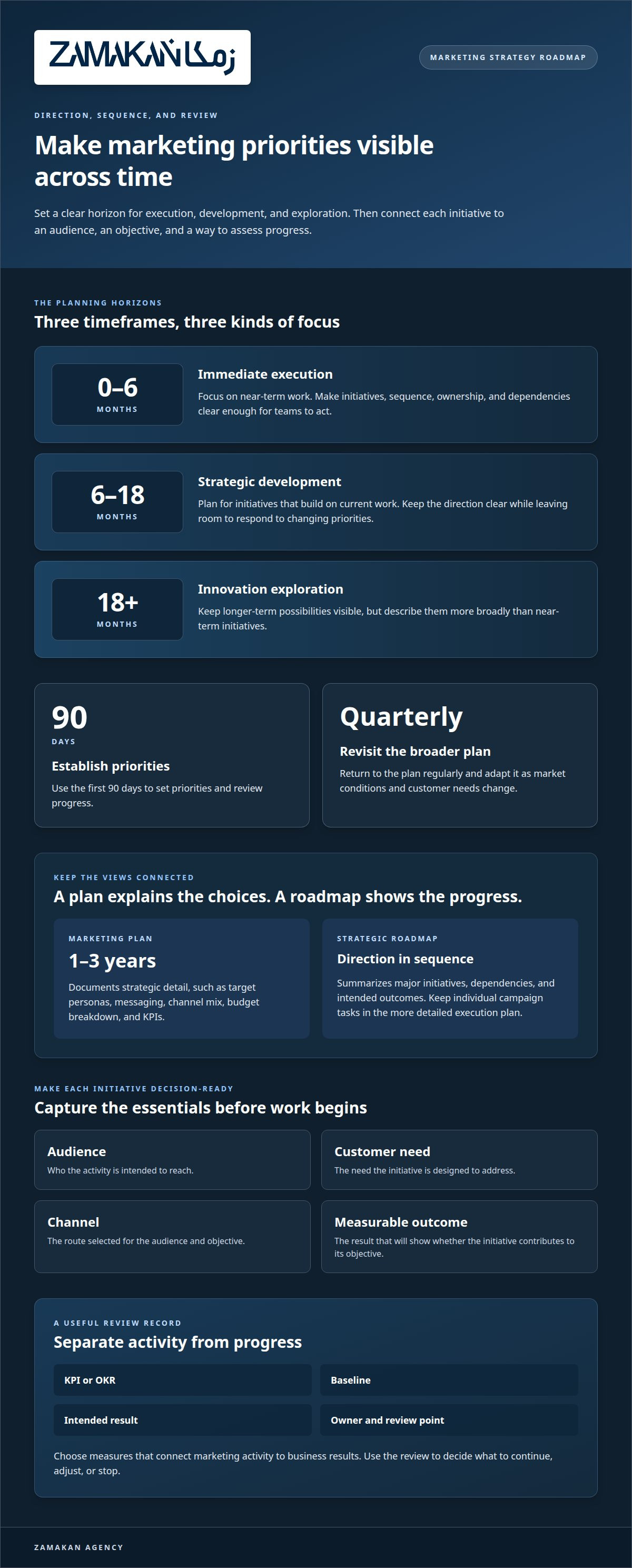
Assign each initiative a KPI or OKR that shows its contribution to the objective, such as qualified leads or conversions. Record the baseline, intended result, owner, and review point so the marketing team can distinguish activity from progress. Avoid choosing metrics simply because a platform reports them. Use measures that connect marketing activity to business results and help decide what to continue, adjust, or stop.
•
Agree with sales on what counts as a qualified lead, how leads are nurtured, and when follow-up begins. This shared process supports a consistent customer journey from awareness to purchase, with clear responsibilities for both teams. Include handoffs and feedback in the roadmap, then review lead quality alongside campaign results. These steps help marketing refine its audience and messages using sales conversations, not assumptions alone.
•
Choose audiences by their relevant demographics, preferences, and buying behaviour, then position the offer around their needs. Select channels according to the objective and audience, rather than assuming one channel works best for every Saudi business. Set the budget by prioritizing initiatives against expected contribution and available resources; review channel performance before reallocating. For timelines, use the 0-6-month horizon for immediate execution, 6-18 months for strategic development, and 18+ months for innovation exploration. In the first 90 days, establish priorities and review progress; revisit the broader plan quarterly.
Build the evidence base before choosing initiatives. A clear sequence moves from analysis to execution and evaluation, keeping research connected to decisions.
•
Gather information about Saudi target customers, industry trends, preferences, and buying behaviour. Segment the audience by relevant demographics, behaviours, and needs, then identify what each group values. For example, compare the questions prospective customers ask with the benefits they prioritize. Use those findings to refine positioning and select channels. Avoid treating broad assumptions as evidence; record how each insight informs the marketing plan and its foundation.
•
Compare competitors’ positioning, messages, channels, and visible customer offers. Look for unmet needs or recurring gaps, not just differences in presentation. For example, if several brands emphasize price, investigate whether customers also value availability, expertise, or service. Separate observations from interpretation, then use the analysis to identify a credible point of distinction. Competitor activity can inform your choices, but it shouldn’t define your strategy.
• Translate research into initiatives with a clear purpose. For each proposed activity, record the audience, the customer need it addresses, the channel, and the measurable outcome. Then map dependencies and sequence the work so execution follows the evidence. This process creates a practical roadmap: research, prioritize, assign initiatives, execute, and evaluate. Avoid adding activities simply because competitors use them; tie each one to your audience and objectives.
• Set a review method before campaigns begin. Compare results with the objective and baseline, then assess which audience segments and channels are contributing. If engagement rises but qualified enquiries remain weak, revisit the message, offer, or audience fit rather than automatically expanding activity. Common risks include stale assumptions, incomplete customer insight, and measures disconnected from outcomes. Use regular analysis to adapt priorities and keep the marketing plan relevant as market conditions change.
Separate long-term direction from the work that brings it to market. This distinction helps teams connect strategic outcomes with practical campaign choices.
•
Define the strategic roadmap around major initiatives, sequence, dependencies, and intended outcomes. It communicates high-level direction to stakeholders and provides an umbrella for campaign, event, and product launch plans. Keep the overall strategy relatively stable as market trends and business priorities evolve. Avoid filling this view with individual tasks; put tactics in a more detailed execution plan, where teams can update them as conditions change.
•
Use the marketing plan to document the strategic detail behind the roadmap. A plan can specify target personas, messaging, channel mix, budget breakdown, and KPIs, while the roadmap visually summarizes what happens and when. A marketing plan usually covers 1-3 years. Keep the two connected: the plan explains the choices, and the roadmap shows how initiatives progress toward growth outcomes.
• Set the roadmap’s level of detail according to how certain you are. Show near-term initiatives with clearer sequence and dependencies, then describe future possibilities more broadly. For example, a planned campaign may depend on completing audience analysis before launch. Mark that dependency instead of assigning unsupported dates or listing every task. This keeps the roadmap useful for decisions without confusing strategic direction with a project schedule.
• Translate each strategic priority into tactical work when the next action is clear. A priority to strengthen competitive positioning might lead to a campaign that tests distinct messages across selected channels. Keep the strategic outcome visible beside those tactics, so teams can adjust execution without losing direction. Review the roadmap as business priorities and market trends shift, while preserving the distinction between lasting intent and changeable activities.
Use the roadmap to clarify decision gates: identify what must be resolved before a significant initiative can proceed, and show how initiatives relate in sequence. Keep calendar dates and individual marketing activities in the execution plan, not the strategic view. Since confidence falls further into the future, give short-term plans more detail and describe less-certain possibilities broadly. The overall marketing strategy should remain relatively stable compared with tactical plans, which can adapt as circumstances change.
A marketing strategy roadmap gives stakeholders a shared view of priorities, sequence, dependencies, and intended outcomes. It turns research insights into coordinated execution while showing enough detail to guide decisions without becoming a task list.
• Design the roadmap for the people who will use it. A leadership view may emphasize objectives, progress, and major decisions, while a marketing team view can show initiative owners and dependencies. Choose a visual format that makes priorities easy to interpret. A timeline suits work with a clear sequence; a list or Kanban-style view can suit independent actions.
• Make resource capacity visible before committing to execution. Organize initiatives by owner or team, then look for workload imbalances and gaps in available skills or time. For example, if one person owns several launch-critical activities, make that dependency visible before approving timelines. This view helps decision-makers adjust scope or sequence instead of treating every initiative as equally resourced.
• Use the roadmap to connect progress with decisions, not simply report completed activities. Pair each initiative with its intended outcome and a review point. If a campaign generates attention but few qualified enquiries, the team can reconsider its message or next action. Keep near-term commitments clear, and describe uncertain future opportunities at a higher level of detail.
• Revisit priorities as customer needs and market conditions change. A quarterly review can surface new insights, stalled dependencies, or initiatives that no longer support business objectives. Record what changed and why, so stakeholders understand the decision rather than seeing unexplained shifts. The roadmap then becomes a working guide for alignment, resource choices, and progress, rather than a static planning document.
Develop a roadmap with strategic guidance when your priorities, resources, and execution need a clearer connection.
A by-person marketing roadmap can help teams identify workload imbalances and determine whether they have enough resources to execute. Grouping initiatives by person makes it easier to spot when responsibilities cluster around one owner or when available capacity may not match planned work. Teams can use that view to reconsider ownership, timing, or scope before execution, keeping resource decisions connected to the roadmap’s priorities.
zamakan Agency helps organizations turn market insight into a coherent marketing direction and coordinated execution. Its ADVISORY offering supports priority-setting and strategic decisions, while BRANDING and MEDIA connect that direction with how the business is positioned and reaches its audience.
Turn to zamakan Agency when research, business objectives, and planned marketing activity need a clearer connection, or when teams need a shared view of priorities and next steps. The work brings strategic choices into focus without confusing long-term direction with campaign-level tactics.
Contact zamakan Agency to discuss aligning your research and marketing priorities.
The next step is to turn your marketing strategy roadmap into a working management tool. Keep it responsive: revisit assumptions when customer behaviour shifts, and make deliberate changes when evidence points to a different priority. This discipline helps teams stay focused without treating the plan as fixed.
When you need support connecting strategic direction with execution, zamakan Agency brings together ADVISORY, MEDIA, and SEO/SEM. These services can help clarify priorities and coordinate how your marketing reaches its intended audience. Start with a focused discussion about the decisions your roadmap needs to support.
Contact zamakan Agency about your roadmap and take the next step toward clearer, more aligned marketing decisions.
Start with a business outcome, then define a specific, measurable, achievable, relevant, and time-bound marketing goal. For example, if the objective is to generate more qualified enquiries, choose a KPI that tracks qualified enquiries rather than general website visits. Set a target using a reliable baseline, assign an owner, and state the review period. This makes progress assessable and helps distinguish useful activity from activity that only looks busy.