A campaign is a time-bound set of coordinated marketing activities built around a business goal, such as increasing brand awareness, generating leads, supporting sales or launching a product. Effective media campaign planning connects that goal to the audiences you need to reach, the channels suited to them and the measures that help assess progress.
Media campaign planning sets the strategy before media buying puts it into action through placements and delivery decisions. This keeps channel choices anchored to business priorities. This guide explains how to plan around those priorities, adjust channel activity as results emerge, and assess cross-platform impact when customer journeys are difficult to track in one view.
• Stay flexible with channel priorities, using forecasting, testing and performance signals to guide decisions.
• Use audience demographics, interests, location and behaviour to choose channels that support the campaign’s business goal.
• Assess cross-platform impact through a combination of engagement, conversion signals and aggregated reporting, rather than relying on reach alone.
• Keep strategy and execution connected: planning sets the audience, channels and objectives, while buying secures and optimizes placements.
Real-time reallocation adjusts a campaign’s channel focus and placements as performance data emerges instead of locking every choice before launch. Forecasts, review points, and clear criteria help keep changes tied to business objectives.
Forecasting estimates how different channel choices may support campaign objectives. AI can help analyse emerging performance patterns, providing another input for planning decisions, not an automatic instruction to change channel activity. Once a campaign is live, professionals compare each platform’s results with its role, such as reach for awareness or qualified actions for lead generation.
A review should separate meaningful patterns from short-term fluctuations. For example, if a channel generates engagement but few desired actions, the message or audience may need adjusting before the channel receives more focus. Testing new formats also lets the team assess their performance and make changes when evidence supports doing so.
The channel mix considers placements, measurement, campaign assets, and the role of each channel. The right mix depends on the objective, audience, campaign duration, and the team’s capacity to manage each platform. In Saudi Arabia, channel choices may also differ across customer groups or locations, rather than assuming one plan fits the whole market.
An awareness campaign may prioritize reach, while a lead-generation campaign may favour placements suited to qualified enquiries. These are strategic choices, not fixed formulas. Planners can test new placements and set decision criteria before launch, including which performance signals justify shifting focus between channels.
A media planning professional builds the plan by connecting business objectives with the audience, channels, placements, and measurement. The schedule sets launch and end dates, milestones, placements, and the team members responsible.
Professionals use planning documents and performance dashboards to organize timing, placements, and results. These tools give teams a shared view for coordinating activity and reviewing changes.
Campaign performance should be assessed against the intended objective. A planner can assess awareness through reach and engagement, or lead activity through qualified enquiries, then review whether reallocations support the intended result.
A successful campaign connects a defined audience with a business goal and a relevant message. For a launch, that means choosing target groups and channels based on evidence rather than assumptions.
Audience research gathers information about demographics, interests, location, and behaviour to define the people a campaign needs to reach. A clearly defined target audience gives planners a stronger basis for decisions about messaging, channels, and timing.
Professionals can segment audiences by shared characteristics or actions, such as existing customers, first-time buyers, or people who have shown interest in a product category. In Saudi Arabia, a plan may distinguish audiences by city or region when location affects access, relevance, or the business objective. Market insight helps determine which differences should shape the campaign.
Audience-based channel choices match each platform to how the target group discovers information and responds to messages. This keeps activity focused on channels that can serve the campaign’s goal.
For example, a campaign aimed at people researching a considered purchase may prioritize channels suited to detailed information, while a brand awareness campaign may seek broader exposure. Planners also consider how audiences move between channels so messages feel connected rather than fragmented. The right mix depends on observed audience behaviour and the intended response.
Professionals plan a campaign by defining its objective, researching the audience, selecting channels, coordinating the message, and setting measures for evaluation. This sequence makes each media decision accountable to the business goal.
They then build a schedule with launch and end dates, milestones, placements, and responsible teams. Objectives should be specific, measurable, achievable, relevant, and time-bound. For a product launch, for instance, the plan can connect audience segments and channel activity to a clear action, then track whether the campaign reaches its intended audience.
Common planning mistakes include targeting too broad an audience, choosing channels without audience evidence, and measuring activity that does not reflect the campaign objective. These gaps can weaken relevance and make it harder to tell whether the plan is working.
A campaign can also become fragmented when teams use different messages or schedules across platforms. Planners reduce this risk by aligning the core message, timing, and audience criteria before launch. They should distinguish useful signals from surface-level activity: high engagement alone does not show that a campaign supports its business goal.
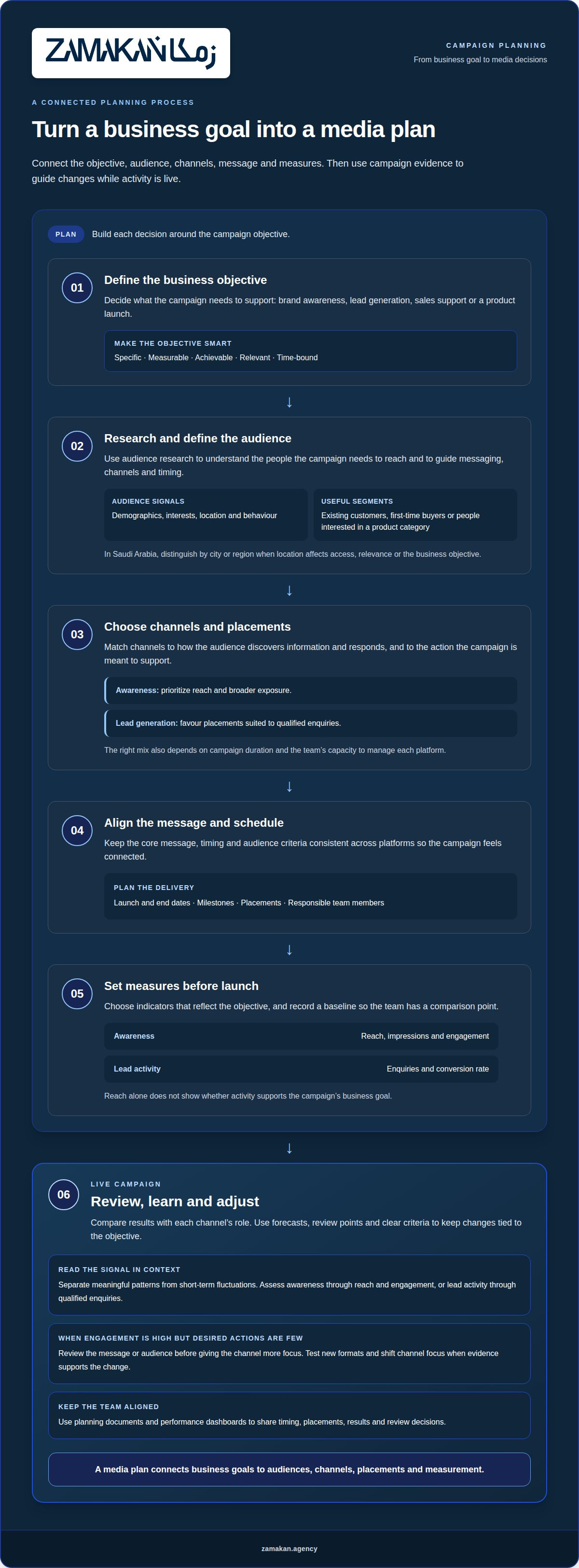
Start with measurable objectives, then select indicators that reflect each one. A brand awareness campaign might track reach, impressions, and engagement, while a lead campaign can monitor enquiries and conversion rate. Setting a baseline before launch gives the team a comparison point. Without one, it is harder to tell whether campaign activity changed the outcome.
Fragmented identity means platforms may not connect activity from the same person into one unified customer journey. Privacy limits on tracking make first-party data, such as information gathered directly through customer interactions, and aggregated reporting more useful. CRM records can reveal patterns among existing customers, such as which audience segments respond to a message. Use these insights to inform planning without assuming every platform interaction can be linked to an individual.
A campaign dashboard brings platform data and business indicators into a regular view. Media planners can review reach and impressions alongside engagement and conversion signals. For example, a course-awareness campaign could track course-page visits, traffic sources, sign-ups, and paid-ad click-through rates. These indicators show different aspects of performance, rather than letting one platform metric stand in for the whole campaign.
Professionals combine attribution models, platform reporting, and aggregated results to assess cross-platform impact. Attribution models assign value to interactions along the path to an outcome, but each has limitations when identities cannot be joined. Planners compare results with the original objectives and baseline, then identify which channels support meaningful outcomes. If reach rises but qualified enquiries do not, they can review audience quality, message relevance, and conversion steps before changing campaign activity.
Continuous monitoring makes optimization possible during a campaign, while a final review captures lessons for future activity. The planner records what changed, which signals informed the decision, and whether outcomes moved toward the objective. This creates a clearer account of performance, even when no single dashboard can identify every cross-platform interaction.
Media planning establishes a campaign’s strategy before placements are secured. It connects business objectives to the audience, channels, timing, and measures of success. Media buying puts that strategy into action by securing placements and monitoring delivery. The distinction matters: buying secures exposure, while planning defines what that exposure needs to achieve.
During planning, professionals determine which audiences to reach, how often to show the message and which formats suit each channel. An awareness campaign may prioritize broad reach, while a conversion campaign may focus on enquiries or purchases. Buyers use those decisions to assess placements across channels. A 30-second TV spot, for example, is a format choice that should fit the planned audience and message.
Buying continues after placements are booked. As activity runs, buyers monitor delivery against the agreed plan and adjust placements where needed. If a platform delivers impressions but little meaningful engagement, the team can assess whether the placement, audience, or message needs attention. Planning sets the criteria for that review; buying manages execution within them.
For a campaign in Saudi Arabia, professionals should assess timing against the business calendar, offer, and audience behaviour. A launch or time-sensitive promotion may call for a schedule that concentrates activity around relevant dates, while ongoing brand activity may need a different cadence. Regional choices should reflect the intended audience and campaign evidence, rather than assuming one schedule suits every market.
The distinction is practical: planning defines the campaign’s direction, while buying handles its media placements. Shared objectives, schedules, and performance measures help teams keep execution aligned. When buying decisions change the intended audience or goal, the team should revisit the plan so every placement continues to serve the campaign’s purpose.
zamakan Agency connects media decisions with business priorities through strategic advisory and media planning and buying. When your campaign needs clearer direction, the team can align its audience, channels, placements, and measures with the intended outcome.
Branding can also be part of campaign planning, helping messages stay consistent across platforms. The focus is a coherent plan and informed execution decisions, rather than treating each placement as a separate activity.
If you’re shaping a campaign and need strategic support, contact zamakan Agency to discuss your media planning needs.
The next step is to turn your campaign’s business goal into a shared operating brief. Align decision-makers on the audience, desired outcome, channel roles, and evidence that will guide adjustments. This gives marketing, sales, and media teams a common basis for decisions, even when platform reporting cannot show every customer interaction.
Before launch, clarify who approves message changes, how performance updates reach stakeholders, and which signals would prompt a review. These decisions help keep the campaign responsive without losing sight of its purpose. Strong media campaign planning is more than a channel schedule; it creates a disciplined route from business intent to accountable execution.
Once the brief is aligned, assign an owner to each decision and agree on how updates will reach the teams involved. This turns strategy into coordinated activity and gives the campaign a clear path forward.
A campaign is a coordinated set of activities designed to achieve a defined objective within a planned period. For example, a Saudi retailer launching a new product might coordinate paid media, social posts, and in-store messaging around one central proposition. The campaign gives those activities a shared purpose, while each channel can adapt the message to its format and audience.
A professional makes the measurement method clear, distinguishes observed results from estimates, and ties reporting to the campaign’s original objective. Ask how platform-reported conversions are separated from confirmed business outcomes, how duplicate actions are handled, and which attribution assumptions apply. A report should also explain limitations so a click or view is not presented as proof that media alone caused a sale.
There is no fixed split that suits every business goal, audience or campaign period. One broad large-brand advertising effectiveness analysis points to a roughly 62:38 split between brand building and short-term activation, but treat this as a reference, not a required budget rule. A new market entry may need more awareness activity; a time-sensitive offer may call for stronger short-term activation.
Media planning is the strategic work of determining how paid placements can support a marketing objective. It translates the brief into decisions about audiences, channels, formats, timing, investment, and evaluation. For instance, a planner may recommend different placements for a brand launch than for a seasonal offer, even when both campaigns target the same customer group.
A professional weighs audience behaviour, campaign purpose, channel context, and the practical requirements of each placement. They also consider whether the format can carry the message clearly and whether the team can coordinate activity across the selected platforms. For a complex service, the plan may favour environments that allow explanation; a simple offer may suit channels that make the next action easy to understand.
Media campaign planning turns a business objective into a coordinated paid-media approach. It can include audience definition, channel and format choices, budget allocation, scheduling, measurement criteria, and review points. The process also clarifies how teams will respond to performance signals, giving your organisation a shared framework for assessing placements and keeping campaign decisions connected to business priorities.