Paid and organic search work best as coordinated parts of one acquisition strategy. An SEO and SEM agency connects search advertising with organic visibility, manages campaigns, and guides website improvements around your business priorities.
For organisations in Saudi Arabia, this approach brings campaign management, analytics, and budget decisions into a clearer framework. Paid search can support visibility while SEO builds organic presence over time. Data from both channels can help guide next steps. The right balance depends on your goals, audience, website, and what your measurement setup can reliably track.
This article explains what an SEM agency does and how its services connect paid and organic search. You’ll learn how campaign management and analytics inform budget decisions, what shapes the quality of the work, and what to consider when choosing a professional partner.
• Coordinate paid campaigns and organic search around shared business goals to create a more consistent presence in search results.
• Set clear campaign objectives and tracking before launch so performance can be evaluated against meaningful outcomes.
• Match campaign services and audience targeting to your business priorities, customer journey, and market.
• Use analytics to identify where budget and effort may have greater impact, while accounting for the limits of the available data.
Paid search and organic listings can give a business more than one place in search results. Coordinating both channels links immediate visibility with longer-term search growth.
SEO can build visibility for relevant searches and reduce long-term reliance on paid advertising, although it takes time. SEM can provide prominent placements sooner. Review whether paid campaigns reveal search terms that could inform organic content. For example, Google Ads conversion data can help prioritize service topics and improve related website pages.
SEM promotes content through paid search advertising, including Google Ads campaigns. Paid search campaigns can use keyword targeting, and some charge based on interactions with ads. Campaign targeting can focus on factors such as location, interests, or search history. Assess whether the audience, ad message, and landing page serve the same business objective.
SEO generally takes longer to show results because website and content improvements need time to support organic visibility. SEM can place ads prominently soon after campaigns launch. The SEO timeline depends on factors such as technical conditions, content relevance, competition, and search demand.
To choose an SEO and SEM agency in Saudi Arabia, assess its proposed scope, reporting approach, and explanation of how paid and organic work support your objectives. Look for clear responsibilities and measurable goals, not promises of rankings or sales.
Agencies serving businesses in Saudi Arabia may work nationwide or focus on particular sectors, audiences, or channels. Match the agency’s proposed experience and campaign approach to your market, customer journey, and business goals.
A useful contract should define deliverables, responsibilities, reporting, account access, and how either party can end the engagement. It should also clarify ownership and access to Google Ads accounts and campaign data.
Risks include unclear reporting, poorly matched targeting, and paid activity without a plan for organic growth. Set expectations for measurement and account access at the outset, then review whether campaign decisions follow the agreed objectives.
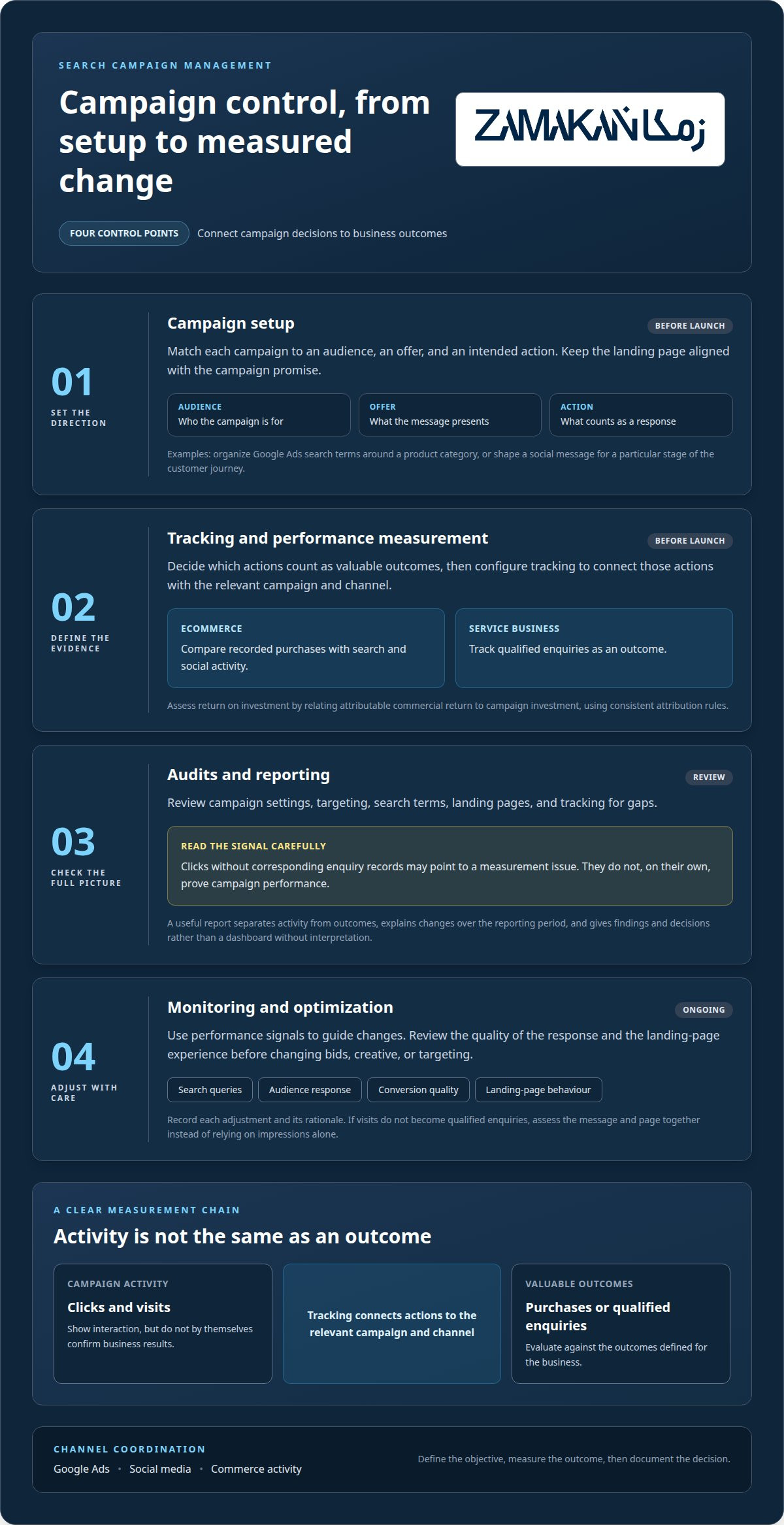
A clear campaign strategy connects channel choices with business outcomes. Google Ads, social media, and commerce activity each need defined objectives and measurement.
Setup begins by matching each campaign to an audience, offer, and intended action. In Google Ads, that may mean organizing search terms around a product category; on social media, it may mean selecting an audience and message for a particular stage of the customer journey. For display campaigns, confirm how placements support the same strategy. Check that each landing page reflects the campaign promise.
Before launch, define which actions count as valuable outcomes, such as a completed purchase or submitted enquiry. Configure tracking to connect those actions with the relevant campaign and channel. An ecommerce business can compare recorded purchases with search and social activity; a service business can track qualified enquiries. Assess return on investment (ROI) by relating attributable commercial return to campaign investment, using consistent attribution rules.
A campaign audit reviews settings, targeting, search terms, landing pages, and tracking for gaps. For example, a Google Ads report may show clicks without corresponding enquiry records, suggesting a measurement issue rather than proving campaign performance. Reports should distinguish activity from outcomes and explain changes over the reporting period. Ask for findings, decisions, and next steps, not a dashboard without interpretation.
Monitoring turns performance signals into considered adjustments. Review search queries, audience response, conversion quality, and landing-page behaviour before changing bids, creative, or targeting. If a campaign attracts visits but few qualified enquiries, assess the message and page together. Record each adjustment and its rationale so your team can evaluate whether it improved results, rather than relying on impressions alone.
Search engine marketing can sit within a broader digital marketing plan alongside search engine optimization, social media, and performance marketing. The right mix depends on your business objective: an ecommerce brand may prioritize product discovery and purchases, while a service firm may focus on qualified enquiries.
Social media optimization strengthens how a brand presents itself across platforms, from profile information to useful, consistent posts. Social media marketing adds paid campaigns to reach selected audiences and support a defined action. For example, a retailer in Saudi Arabia could align a seasonal promotion across social media and search, using distinct messages for discovery and purchase intent.
As a general industry example, digital marketing training courses may help internal teams understand channel roles, measurement, and content planning. One course listing gives a duration of 4 to 6 months. This is an example of training available in the wider market, not a recommendation to treat courses as part of an agency’s service scope. Assess training against the team’s actual responsibilities.
SEO content marketing supports organic visibility by creating relevant pages around customer needs and search intent. Outreach can help content reach relevant publishers or industry audiences, but should reinforce useful material rather than replace it. A practical sequence is to identify a content gap, develop a useful resource, then assess whether it attracts qualified visits or engagement.
Performance marketing case studies are most useful when they explain the starting point, channels, changes, and measurement method. One reported case study described a 57% change in campaign performance after changes to Meta and Google Ads management. Treat that result as an example, not a forecast: campaign outcomes depend on audience fit, offer, landing page, and tracking quality.
When reviewing a marketing agency’s proposed scope, map each activity to an outcome and an owner. A channel plan should clarify whether the work covers strategy, campaign management, content creation, or measurement, and how those parts connect. This makes it easier to assess whether the agency can support your digital priorities.
Google Analytics and advertising platforms need consistent conversion definitions before reports can guide investment. A purchase, qualified enquiry, and newsletter signup are different outcomes. Track them separately so campaign analysis reflects actions relevant to your organisation, not just traffic or clicks.
Tag management organizes tracking tags that record website activity. For example, an ecommerce site can track product views, purchases, and checkout abandonment. Review whether those events register accurately across landing pages and devices. Incorrect or duplicate tags can distort analytics and lead to poor budget decisions.
Conversion rate optimization improves the share of visitors who complete a desired action. Assess a landing page’s message, form, page speed, and next step against the advertising that brought visitors there. If a Google Ads campaign promotes a specific service, its landing page should explain that service and make the enquiry route clear.
Reporting should connect campaign activity with meaningful business outcomes. A useful report helps teams trace relevant conversions to channels and identify where further analysis is needed. Treat dashboards as decision aids, not proof that advertising caused every recorded sale. Consistent definitions also help teams interpret results across channels.
Technical SEO and content optimization address different barriers to organic performance. Technical work can improve page access and structure; content work can make information more relevant to search intent. An audit might identify a service page with unclear headings or missing information, then prioritize improvements according to user needs.
There is no single typical Google Ads budget for a Saudi business. Set it according to campaign goals, search demand, auction competition, conversion performance, and the value of a qualified customer. These factors can also guide adjustments as performance data accumulates.
Review channel results alongside landing-page conversion data before reallocating budget. If paid traffic reaches a relevant page but rarely converts, investigate the offer and user experience before increasing advertising. This keeps optimization grounded in evidence rather than assumptions.
There is no single typical budget. Set it according to campaign goals, search demand, auction competition, conversion performance, and the value of a qualified customer. Review results alongside landing-page conversion data before adjusting spend.
zamakan Agency helps organisations connect SEO and SEM decisions with broader marketing priorities through Advisory, Media, SEO/SEM, and Branding. Its work can support you when search activity feels fragmented, campaign data does not clarify priorities, or paid and organic efforts need a more coordinated direction.
A practical starting point is to understand your objectives, audiences, existing campaigns, and measurement approach. zamakan Agency can then shape a strategy linking search visibility with media planning and brand relevance, and use technical or content audits to inform next steps. This gives your team a clearer basis for allocating resources and evaluating performance without assuming one channel will deliver the same result for every business.
Contact zamakan Agency to discuss how your search strategy can better support your organisation’s goals.
Sustainable search growth starts with a clear decision about what to improve next. Identify the business outcome that matters most, then align your search activity, measurement, and available resources around it. This keeps the strategy focused on useful progress rather than channel activity for its own sake.
The right SEO and SEM agency should help you make those choices with clarity and accountability. Zamakan Agency brings Advisory, Media, and SEO/SEM into its strategic work, helping organisations connect search priorities with broader marketing decisions. Take the next step by discussing your objectives with Zamakan Agency and shaping a direction grounded in your business context, without assuming a particular result.
Bring your priorities into focus and decide where coordinated search activity can support your organisation’s growth. Contact Zamakan Agency to discuss your next steps. With a considered plan and clear measures, your team can move forward with purpose.
An SEO and SEM agency helps a business improve its search visibility through organic optimization and paid search campaigns. Its team may assess website content, technical barriers, keyword opportunities, and advertising objectives, then connect the work to business goals. For example, a retailer may use paid search to test product demand while improving relevant category pages for ongoing organic discovery.
SEM, or search engine marketing, refers here to paid promotion on search engines. A business uses campaigns such as Google Ads to place relevant ads in response to searches or other targeting criteria. Teams typically define the audience and desired action first, then structure campaigns around those priorities. For a service firm, that action could be a qualified enquiry rather than a page visit.
SEO, or search engine optimization, improves a website’s ability to appear in organic search results. It includes technical work that helps search engines access and understand pages, as well as content that addresses relevant customer needs. For example, a service page should clearly explain its subject and answer questions a prospective customer may have before making contact.
Services can include technical and content audits, organic search strategy, paid search campaign planning, and measurement guidance. A business may also need landing-page recommendations or media planning so search activity supports wider marketing objectives. The right scope depends on the challenge: a site with technical issues needs different work from a campaign attracting visits but few qualified enquiries. Define deliverables around business needs.
Review whether the proposed scope addresses your search objectives, website needs, and campaign priorities. Clarify which tasks the agency will complete, who is responsible for each, and how progress will be measured and reported. Ask how the agency will adapt its work if results or business priorities change. These details help you judge whether the deliverables fit your needs.
SEO focuses on improving a website’s organic search visibility, while SEM here refers to paid search advertising. SEO work can strengthen a site’s relevance and accessibility over time; paid campaigns can place ads for selected searches while they run. For example, a business can use SEO to build useful service pages and SEM to promote a specific offer to active searchers.