
To understand how to choose a branding agency, compare its strategic process, relevant work, project team, timeline, communication approach, and clarity about scope before you commit. A strong fit is not simply the agency with the most polished portfolio; it is a partner that can explain how it will understand your organisation, shape a coherent brand direction, and carry the work through with clear responsibilities. You’ll learn what to ask about research, strategy and design, who will lead the project, how feedback and revisions are handled, what affects the proposed scope, and how to assess timing against your business priorities in Saudi Arabia.
• Assess whether an agency’s work shows strategic reasoning and relevant results, not just polished visual identities.
• Ask who will lead the work, how your team will collaborate, and what milestones shape the project timeline.
• Define the brand work and deliverables clearly so proposals can be compared on scope and purpose.
• Plan feedback and communication early, and consider how branding connects with advisory, media, or SEO/SEM needs.
Start by comparing three branding studios whose portfolios relate to your organisation’s goals. Relevance doesn’t require an identical industry; look for evidence that the agency understands a business challenge and can explain its approach. A useful case study connects the problem, strategic thinking, creative decisions, and outcome. A gallery of polished marks alone reveals little about how the work was developed or whether it worked.
Look beyond visual style. Review how each portfolio handles different audiences, sectors, and brand needs, including a refresh as well as a new identity. Ask what informed the verbal and visual choices, and how those choices support the organisation’s direction. Strong case studies describe the starting point, the agency’s contribution, and a measurable result. Check that each result relates to the work, rather than relying on broad claims about growth or recognition.
To find a reputable branding agency in Saudi Arabia, assess local relevance alongside evidence of sound strategy, clear working methods, and credible client references. Ask to speak with a past client, and examine whether the portfolio explains the reasoning behind the work. Consider how well the agency understands the audiences and business context your brand needs to reach.
Watch for red flags in both the portfolio and sales process. Results without context, repeated designs with no explanation, or claims that every project followed the same formula deserve closer scrutiny. So does pressure to commit before the agency understands your objectives. Compare three studios against eight criteria, scoring each from 1 to 5. Include portfolio relevance, strategic reasoning, range, evidence of results, and clarity of communication. This makes the choice a considered decision, not a contest in presentation polish.
Compare agencies for local relevance, sound strategy, clear working methods, and credible client references. Review case studies for the reasoning behind the work and its results, and ask to speak with a past client; be cautious of unsupported claims or pressure to commit before the agency understands your objectives.
Before comparing proposals, ask each agency to outline discovery, strategy, identity development, review, and implementation. Request a project plan that shows key decisions, your team’s inputs, and approval points. A clear process explains how audience understanding and business goals inform visual choices. Ask what evidence guides each stage and how findings could shape the creative direction. Compare the plan with your launch date and business priorities.
Ask how much project time is reserved for strategy before visual design, and what factors inform that allocation. If an agency proposes 30-40% of project time, ask it to explain the basis for that estimate and how it fits your project. Clarify which workshops involve your team, who records decisions, and how feedback moves forward. Ask how the process handles a change in direction.
Your agreement should define scope, deliverables, milestones, approval responsibilities, revision rules, and how changes are handled. It should state ownership and usage rights for the final identity, source files, and commissioned assets. Ask it to identify third-party materials and any limits on reuse. Review these terms before signing so your team understands how it can apply the visual system across channels.
Meet the people leading strategy and design, not only the proposal presenter. Confirm who attends workshops, manages communication, and approves decisions. Request a timeline with dependencies, review windows, and client deadlines. If an agency estimates 2-4 months for the project, ask how scope, research, refinement, and approval timelines support that estimate. Agree how the agency will raise delays and reset dates.
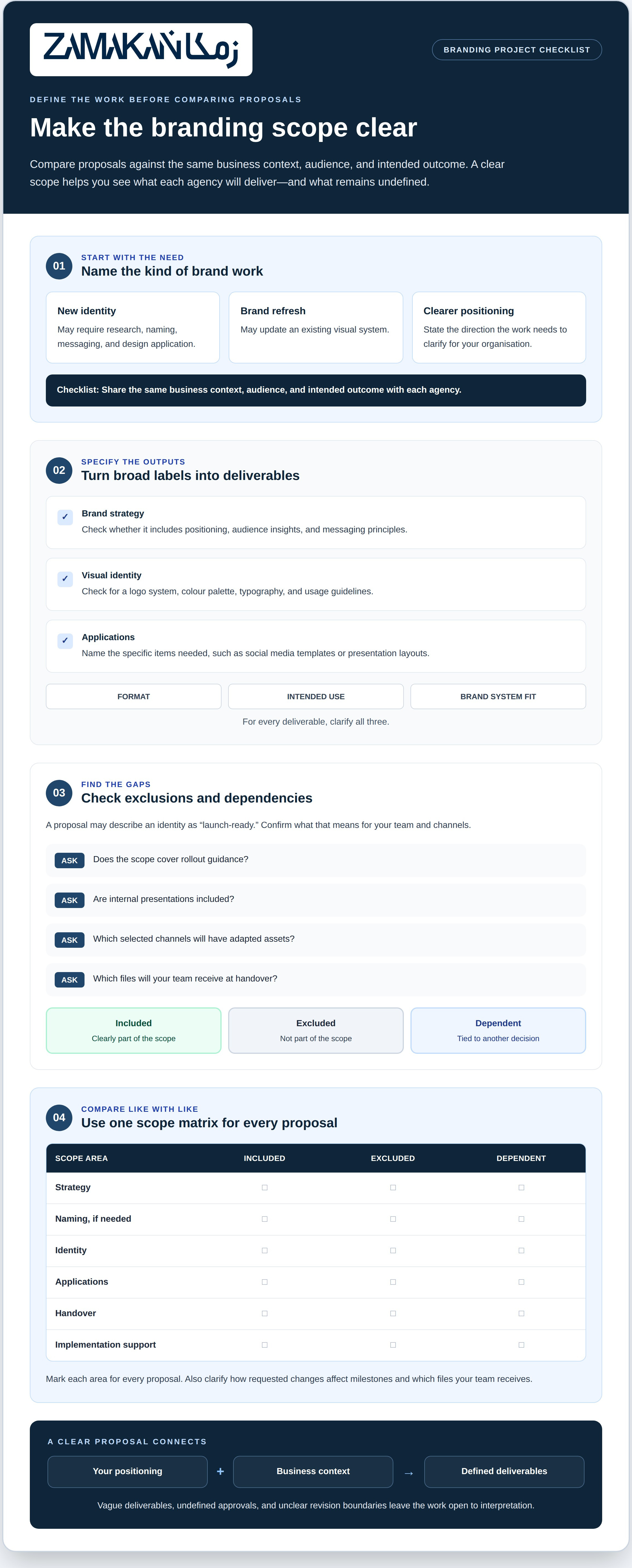
Before comparing proposals, define whether you need a new brand identity, a refresh, or clearer positioning. These projects address different needs. A refresh may update an existing visual system, while a new identity can require research, naming, messaging, and design application. Give each agency the same business context, audience, and intended outcome. Then compare what each proposal actually includes.
Ask for specific deliverables, not broad labels. A brand strategy might include positioning, audience insights, and messaging principles. A visual identity could include a logo system, colour palette, typography, and usage guidelines. Applications might cover particular items, such as social media templates or presentation layouts. Each deliverable should state its format, intended use, and relationship to the brand system.
Read the scope for exclusions and dependencies. If a proposal includes a launch-ready identity, clarify whether it covers rollout guidance, internal presentations, or adapting assets for selected channels. A logo file alone, for example, may not give a team what it needs to keep campaign materials consistent. Vague deliverables, undefined approvals, and unclear revision boundaries are red flags because they leave the workload open to interpretation.
Compare proposals against the same scope matrix: strategy, naming if needed, identity, applications, handover, and implementation support. Mark each as included, excluded, or dependent on another decision. Ask how requested changes affect milestones and which files your team receives at handover. A useful proposal connects each deliverable to your positioning and business context. That clarity helps distinguish a complete brand system from a narrow design exercise.
Agree on a communication rhythm before the first workshop. For example, schedule a weekly project call for decisions and use a shared document to record feedback, open questions, and action owners. Ask the agency to explain what each consultation needs to resolve. This keeps discussions focused, gives absent stakeholders a clear record, and helps your team separate strategic decisions from minor visual preferences.
Build feedback windows into the timeline, rather than treating review time as spare capacity. Clients should aim to respond within 3-5 days, so the agency can maintain momentum between stages. Assign one internal lead to gather comments and resolve conflicting views before sending consolidated feedback. If a product launch or campaign creates a fixed deadline, explain its business importance early.
Ask the agency to document milestones, dependencies, and how delays will be handled. A late approval can affect design refinement or implementation, while new requests may change the sequence of work. Agree on how to raise risks, revise dates, and record decisions. If a rebrand needs input from several departments, schedule consultations around key review points.
Communication should continue through handover, not stop when final files arrive. Confirm that the team will receive usable brand guidelines and knows where to direct questions about applying them. Agree how success will be assessed six months after the work begins, using measures tied to the original objectives. Discuss whether later support or art direction is needed as new campaigns and channels emerge.
Communicate openly, give feedback, and raise concerns. Project timelines vary depending on the work involved and the availability of both the agency and the client. Discuss support or art direction.
zamakan Agency develops, audits, and executes branding concepts for campaigns and corporate communication. Its branding work may suit your organisation when you need a clearer brand direction, a refreshed identity, or consistent communication across customer touchpoints. A useful starting point is to define the business challenge, the audiences involved, and where the current brand no longer supports your goals. That context helps shape relevant work.
Advisory may be relevant when your team needs to connect marketing choices with broader business objectives. For example, an organisation preparing a campaign may need its brand direction aligned with media planning, audience decisions, and channel priorities. zamakan Agency’s media services include planning and buying shaped around campaign objectives. This connection helps teams make coordinated decisions rather than treating brand and media as separate activities.
If your brand also needs a stronger presence in search, zamakan Agency’s SEO/SEM services include technical and content audits to identify performance gaps. Their findings can inform improvements to your digital presence and help keep communication aligned with brand priorities. The right starting point depends on your organisation’s needs: branding, advisory, media planning, or a search audit each addresses a different challenge. A clear brief helps focus the discussion.
As you decide how to choose a branding agency, consider whether its approach connects strategic direction with practical marketing decisions. zamakan Agency offers branding, advisory, media, and SEO/SEM services that can work together when they support your objectives. Your goals, audiences, channels, and current materials can help focus the discussion and clarify the work that matters most to your organisation.
If you’re ready to discuss your branding needs, contact zamakan Agency to start a conversation.
Check whether portfolio examples remain clear and usable across formats. A logo that reads well on a large presentation may be harder to recognise on a small screen or printed item. Look for legibility, contrast, and consistency in examples shown at different sizes. If your organisation communicates in multiple languages, ask how the identity can accommodate those language needs while staying clear.
The right service mix depends on the work your organisation needs to complete. A business with an established strategy may need identity development and application, while a new venture may first need help articulating its market position. Consider where your internal team already has expertise, then identify the gaps an agency should address. This keeps the engagement focused on the decisions and capabilities your organisation needs.
Assess whether each case study explains how results were measured. Ask what baseline the agency used, which metric changed, and what period the measurement covered. For example, an increase in enquiries is more meaningful when you know how enquiries were counted and whether the same method was used before and after the work. This helps you judge the evidence without assuming the same outcome will apply to your organisation.
Ask what your organisation needs to provide for the work to begin. This may include existing brand materials, relevant research, product information, or time with people who understand customer needs. Clarify who will provide each input and when it is needed. Also ask how the agency will handle sensitive business information and document decisions and approved materials for your team.
Compare how each option will cover the work from initial strategy through implementation. An agency may coordinate capabilities across disciplines, while a freelancer may offer direct access to one specialist’s expertise. Ask who handles tasks outside the lead person’s focus and how continuity is maintained if responsibilities shift. The better fit depends on the breadth of work and how your team prefers to collaborate.


